
Summarize this article with AI(click one of the models and ctrl+v)





Ask a hotel front-office manager or a restaurant group operations lead what happens between 6pm and 9pm and you will hear the same story. The floor is full, the queue at the door is growing, and the phone keeps ringing. Someone answers on the fourth ring, takes half a booking, promises to call back, and never does. Nobody is being careless — the team is simply being asked to serve the guests in front of them and the guests on the line at the same time.
In Hong Kong this pressure is amplified. Groups run dozens of sites across dense districts, callers switch between Cantonese, English and Mandarin mid-sentence, and expectations are set by instant digital service in every other part of life. The phone line is where all of that lands.
Why multi-site phone lines are so hard to staff
A single site with one line is manageable. A group with twenty sites is a different problem. Call volume is spiky and correlated: everyone calls a restaurant at the same hours, everyone calls a hotel around check-in and check-out, and everyone calls a retail branch when a promotion lands or a delivery is late.
- Peaks cannot be staffed economically. Rostering for the busiest thirty minutes of the day means paying for idle capacity for the other twenty-three hours.
- The people answering are also serving guests. Front desk and floor staff are interrupt-driven, and the guest physically present always wins.
- Turnover erases knowledge. Every new hire has to relearn opening hours, menu details, room types, cancellation policies and which branch stocks what.
- Language coverage is uneven. The colleague who handles Mandarin enquiries confidently may not be on shift when the call arrives.
- After-hours calls simply go nowhere. Voicemail is rarely checked before the next service period, by which time the booking is gone.
The anatomy of a hospitality and retail call load
Before deciding what to automate, it helps to see what actually arrives on the line. Across hotels, F&B and multi-site retail the calls fall into four recognisable groups.
1. Reservations and bookings
Table bookings, room enquiries, private-room and event requests, group bookings, changes and cancellations. These are transactional, highly repetitive and directly tied to revenue. They also have a short shelf life — a caller who cannot book now will book somewhere else within minutes.
2. Guest requests and in-stay service
Extra towels, late checkout, housekeeping timing, a faulty air conditioner, a request for a high chair, a lost item. These are operational: the caller does not want information, they want something to happen and someone to be accountable for it.
3. Cross-branch and cross-site enquiries
“Does the Causeway Bay branch have this in size M?” “Which of your restaurants opens on a public holiday?” “Can I collect at Tsim Sha Tsui instead?” These calls are the hardest for a single-site team to answer, because the information lives somewhere else.
4. Complaints and escalations
Service issues, billing disputes, quality problems, delays. Low in volume, high in consequence. Handled badly, they become public reviews; handled well, they become retention.
Where the front-desk model breaks down
The traditional answer is “the front desk picks up”. That works until the operation reaches any real scale, and then it fails in five predictable ways.
| Symptom | Root cause | Commercial impact |
|---|---|---|
| Calls abandoned at peak hours | Staff serving on-site guests first | Bookings lost to the next name on the list |
| Bookings written on paper or in a chat group | No structured intake at the point of contact | Double bookings, no-shows, disputes at the door |
| Guest requests never reach the right team | Verbal handover between shifts | Repeat calls, complaints, poor review scores |
| Cross-branch questions bounced around | Branch knowledge is not shared or searchable | Caller gives up; sale leaves the group entirely |
| No record of what was promised | Calls are not logged in a reviewable form | No accountability, no data to improve service |
The revenue cost of a missed call
Missed calls feel invisible because nothing is recorded — which is exactly why they are underestimated. Put rough numbers on it and the picture changes fast. A restaurant group taking 60 booking calls a day per site and missing one in five loses 12 potential covers-worth of enquiries daily, per site. Multiply by the number of sites and by the average spend per booking, and the annual figure usually dwarfs the cost of fixing the phone line.
The same arithmetic applies to hotels, where a single missed room enquiry can be worth several nights, and to retail, where a stock question that goes unanswered sends the customer to a marketplace instead of a branch.
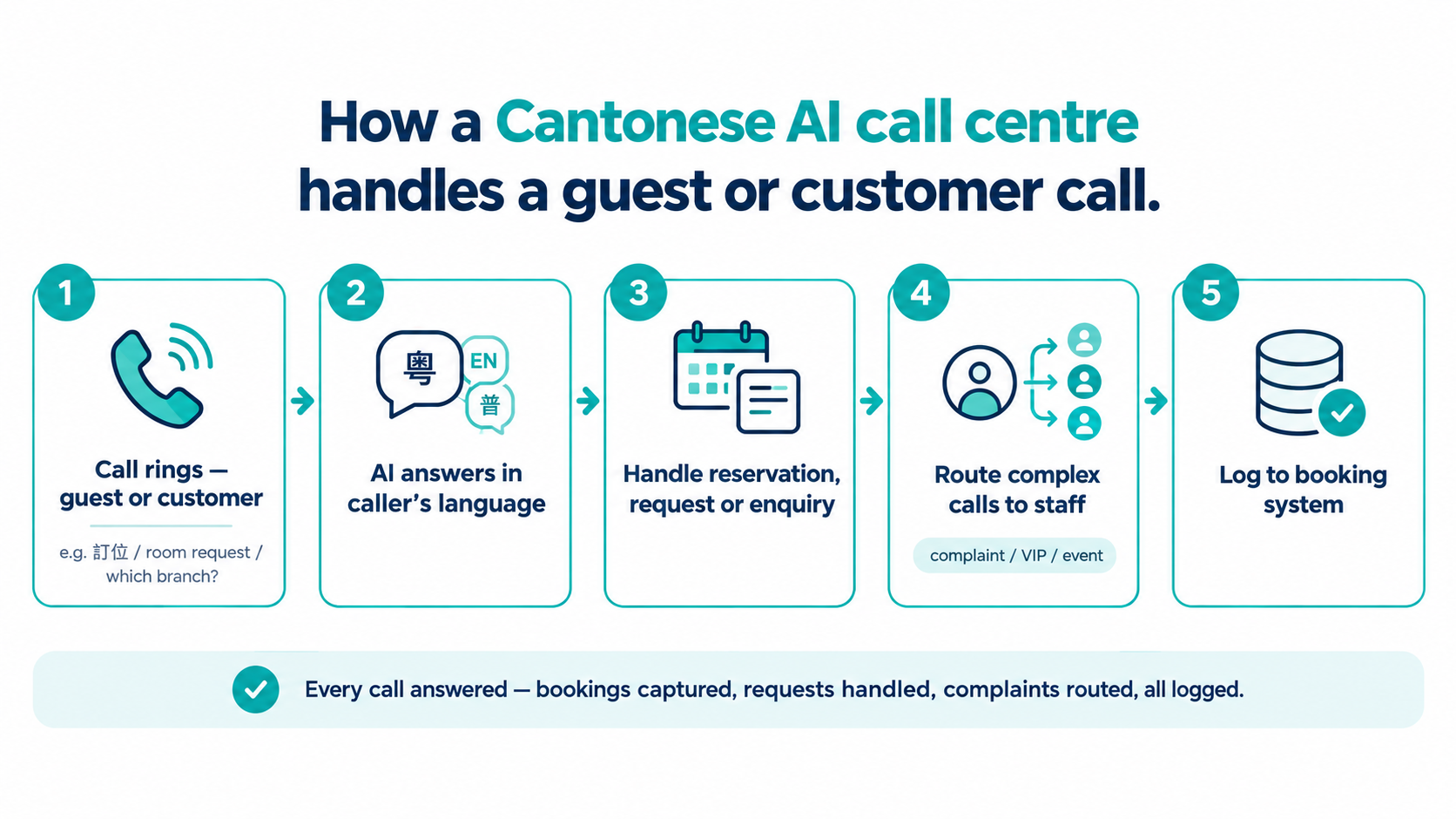
The workflow: answer → handle → route → log
A Cantonese AI call centre is not simply a voice that says “please hold”. The value comes from running the whole sequence end to end, exactly as a well-trained team member would.
- Answer. Every call picked up on the first ring, in Cantonese, English or Mandarin, at any hour and at any volume — no queue, no voicemail, no overflow.
- Handle. Routine enquiries resolved in the conversation: hours, location, menu and price questions, parking, policies, availability.
- Route. Anything that needs a human or another site handed over with full context — the right branch, the right department, the right priority.
- Log. Every call turned into a structured record: caller, intent, site, what was promised and by when, with the transcript attached.
That last step is what converts a phone system into an operations tool. With a work order created automatically from every call, a guest request stops depending on someone remembering it.
Reservations and bookings
The AI takes the booking details in the caller's own language, confirms date, time, party size, contact number and special requests, and writes them into a structured record rather than a notepad. Changes and cancellations are handled the same way, and the caller receives confirmation instead of a promise to call back.
Guest requests and in-stay service
A request for late checkout, housekeeping or a repair becomes a ticket with a category, a priority and an owner. Urgent items — a leak, no hot water, a stuck lift — are escalated immediately rather than queued behind routine questions.
Cross-branch enquiries
Because the AI answers from a shared knowledge base rather than one branch's memory, it can answer group-wide questions consistently: opening hours by site, holiday schedules, service availability, collection options. When the answer genuinely requires the branch, the call is routed there with the question already captured.
Complaints and escalations
Complaints are recorded verbatim, classified, and escalated to a manager with the transcript attached — so the person who calls back already knows what happened. Nothing depends on a guest repeating their story a third time.
How to evaluate a Cantonese AI call centre
Not every voice system is built for hospitality volume or Hong Kong's language reality. Practical questions to ask any vendor:
- Cantonese first, not translated. Does it handle natural Cantonese with English and Mandarin code-switching mid-sentence — including brand names, street names and menu items?
- Latency. Does the reply come back fast enough to feel like a conversation, not a walkie-talkie?
- Multi-site awareness. Can it answer per-branch questions from one shared knowledge base, and route to the correct site?
- Structured output. Does every call produce a record your team can act on and audit, not just an audio file?
- Human handoff. Can it hand a caller — or a WhatsApp conversation — to a person or a group chat without losing context?
- Omnichannel coverage. Do phone, WhatsApp and other channels feed the same workflow, so a guest can switch channel without starting again?
- Integration. Can it write into the reservation, PMS or ticketing tools you already run?
Teams that get results usually start narrow — one call type, one site, clear success metrics — then extend once the handoff is reliable. That is the same staged logic behind adding AI without replacing your existing systems.
What good looks like after a few weeks
The change is rarely dramatic on day one; it shows up in the numbers a month later. Calls are answered on the first ring at 8pm. Bookings arrive in one consistent format. Guest requests have owners and timestamps. Managers stop reconstructing what happened from memory and start reading it from a log. Front-desk staff go back to doing what they were hired for — looking after the guest standing in front of them.
The phone line stops being the weakest link in the guest experience and becomes the most reliable part of it.
FAQ
Can AI really take a restaurant booking correctly in Cantonese?
Yes. The AI confirms date, time, party size, contact number and special requests back to the caller, and writes the booking into a structured record — including callers who switch between Cantonese, English and Mandarin.
What happens to calls it cannot handle?
They are routed to a person with full context: what the caller asked, which site they need, and any details already captured. The caller never has to start again.
Can one system serve all our branches?
Yes. Branch-specific information — hours, availability, services, holiday schedules — lives in one shared knowledge base, so any caller gets a consistent answer and is routed to the right site.
Does it work outside opening hours?
That is where it earns most of its value. After-hours reservation enquiries and guest requests are captured and logged instead of going to voicemail, so the team starts the day with a queue of real leads rather than missed calls.
How does it handle complaints?
Complaints are logged verbatim, classified and escalated to a manager with the transcript attached, so follow-up happens quickly and the guest is not asked to repeat the story.
Do we need to replace our reservation or property management system?
No. The AI acts as the intake and follow-up layer and hands structured information into the tools you already use.