Summarize this article with AI(click one of the models and ctrl+v)





The moment AI enters the conversation, a familiar concern appears: “Do we have to rip out what we already have?”
For most property and facility teams the answer should be no.
You already have a property management system, a ticketing tool, WhatsApp groups, contractor lists, and years of operational knowledge embedded in how the team actually works. Replacing all of that at once is expensive, disruptive, and usually unnecessary.
The smarter question is not “Which system should we switch to?” It is “How do we add an intelligent layer that works with what we already run?”
The real cost of “rip and replace”
Full system replacements often fail for practical reasons. Staff resist learning a completely new interface. Historical data is messy to migrate. Integrations that used to work suddenly break. The project timeline stretches, and the promised benefits arrive late — if they arrive at all.
Meanwhile the original problems remain: missed calls, incomplete notes, inconsistent urgency decisions, and weak visibility after the call ends. Replacing the core system does not automatically fix the operational gaps that sit between the phone and the completed job — which is exactly why so many call centres fail after the call ends.
This is why many teams that try a big-bang replacement end up running the old process in parallel and wondering why the new software feels like extra work.
What “integration-first” actually looks like
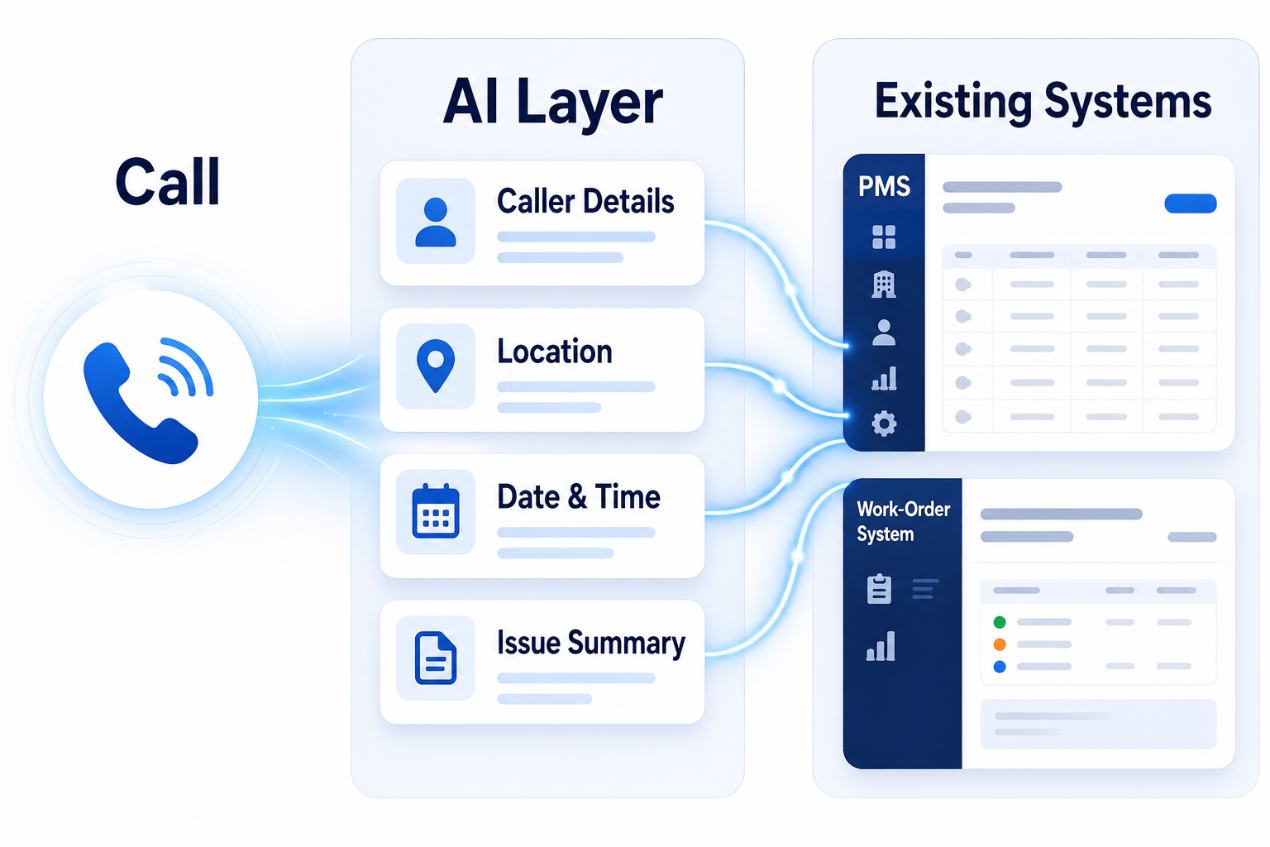
A modern AI operations layer does not need to become your single source of truth on day one. It needs to do three things well:
- Capture structured information at the point of contact (the call or message).
- Hand that information cleanly into the systems your team already uses.
- Keep a reliable record of what happened so ownership and status stay visible.
When those three pieces work, the existing stack becomes more valuable rather than obsolete. Work orders appear with better data. Dispatch happens with clearer context. Managers see progress without chasing updates across channels.
Routiq is built around this approach. It sits as the operations layer that turns every call into structured action — answering in Cantonese, English or Mandarin, classifying the issue, creating the work order, and routing it — while connecting into the tools your team already relies on. Handling spoken, code-switched calls properly is the foundation here, which is why Hong Kong teams need Cantonese voice AI, not just English chatbots.
You keep your current systems. You improve the layer that was previously the weakest: the moment a resident or contractor first makes contact.
What changes (and what stays the same)
What changes:
- Calls are answered consistently, including after hours.
- Details are captured in structured fields instead of free-text notes.
- Urgency and category are decided by clear rules rather than individual judgment alone.
- The handoff to the next team or contractor contains the information they actually need.
- Managers gain live visibility instead of waiting for end-of-day reports.
What stays the same:
- Your existing property management or maintenance system remains the place where work is tracked and closed.
- Your team’s operating procedures and escalation paths continue to apply.
- Contractors and on-site staff keep using the channels they already know.
- Historical records and compliance requirements stay intact.
This is the difference between adding capability and forcing a migration. The goal is to close the loop after the call without asking the organisation to relearn everything at once.
How to evaluate an integration approach
When you assess any AI system, ask these practical questions:
- Can it create or update work orders in the tools we already use?
- Does it support the languages and code-switching patterns our callers actually use?
- Can we start with one building or one call type and expand later?
- Is the data model clear enough that ownership and status remain visible?
- Does the vendor treat integration as a core capability or as an afterthought?
Teams that get the best results usually begin small: one high-volume call type, one pilot site, clear success metrics. Once the handoff is reliable, they expand. This staged approach reduces risk and builds internal confidence far faster than a large replacement project. It is also the same reasoning behind choosing to buy rather than self-develop an AI call and dispatch layer.
The same principle applies to the broader shift toward AI-powered operational workflows. The winners are not the organisations that replace the most systems. They are the ones that make the systems they already have work together more intelligently.
The quiet advantage of working with what you have
There is a practical advantage that is easy to overlook. When an AI layer respects the existing stack, the organisation retains institutional knowledge instead of discarding it. Staff do not have to abandon the tools they trust. Data does not have to be forced through a painful migration. The improvement shows up in daily operations rather than in a project plan.
Over time the AI layer can become the most consistent part of the process — the place where every request is captured cleanly and every case has a clear owner. The rest of the stack continues to do what it already does well.
That is a more realistic path for most property and facility teams than a full system replacement. It delivers the benefits of intelligent intake and dispatch while protecting the investments and habits the organisation has already built.
FAQ
Do we need to replace our current property management system to use Routiq?
No. Routiq is designed to work as an operations layer that captures and structures requests, then hands them into the systems you already use.
How long does integration usually take?
Most teams start with a focused pilot — one call type or one site — and expand once the handoff is reliable. Full replacement projects are not required.
Will our existing work-order and dispatch processes still work?
Yes. The goal is to improve the quality of the information that enters those processes, not to force a completely new way of working overnight.
What if we have multiple systems across different buildings?
A staged approach works well. Begin where the pain is highest, prove the value, then extend. Consistency improves as more of the portfolio shares the same intake layer.
Is data security handled during integration?
Clear data governance, retention, and access controls should be part of any evaluation. Ask for specifics on storage, encryption, and how conversation records are managed.
What is the biggest risk of trying to replace everything at once?
Disruption. Staff resistance, data migration problems, and broken integrations often delay the very benefits the new system was supposed to deliver. Integration-first reduces that risk.