
Summarize this article with AI(click one of the models and ctrl+v)





Background
Facility and maintenance teams that want to improve call handling and work-order quality usually consider three main paths: building a system in-house, outsourcing to a traditional call centre, or using a purpose-built platform.
Each option has its place. The better choice depends on what problems you most need to solve — especially around the completeness of information, after-hours coverage, and operational visibility.
1. Self-develop
Building your own system offers the highest degree of control and the ability to customise deeply. For organisations with strong internal technical resources and a long development horizon, this can be an attractive route. In practice, several challenges often appear:
- Achieving reliable performance with natural spoken Cantonese and everyday language mixing takes significant time and data
- Extracting structured details (exact location, urgency, access, safety context) during a live call is more complex than producing a basic transcript
- Work-order creation, classification rules, dispatch logic and integrations still need to be built and maintained
- Ongoing monitoring and edge-case handling become a continuous responsibility
The linguistic side alone is non-trivial; the difficulties of accurate recognition in real Hong Kong speech patterns are explored further in how voice systems handle Cantonese. Many internal projects reach a functional demo stage but require sustained effort to become stable enough for everyday operational use, particularly at night.
2. Traditional outsourcing
Outsourcing the phone line is often the fastest way to ensure calls are answered, especially outside normal working hours. It removes the need to staff a full night team and can be relatively quick to set up. The limitations usually appear further down the process:
- Notes taken by agents are sometimes brief, and important details can be missing
- Exact location, access instructions or safety context may not always be captured consistently
- Real-time visibility for operations managers is often limited
- Quality can vary between shifts or individual agents
This mirrors a pattern seen across many property and facility operations: the call itself may be answered, yet the information that reaches the next team is frequently incomplete. The consequences of that gap are examined in more detail when looking at what tends to break after a call ends. For teams whose primary goal is simply to avoid missed calls, outsourcing can work well. When the bigger issue is incomplete information reaching technicians or contractors, the benefits remain partial.
3. Purpose-built platform
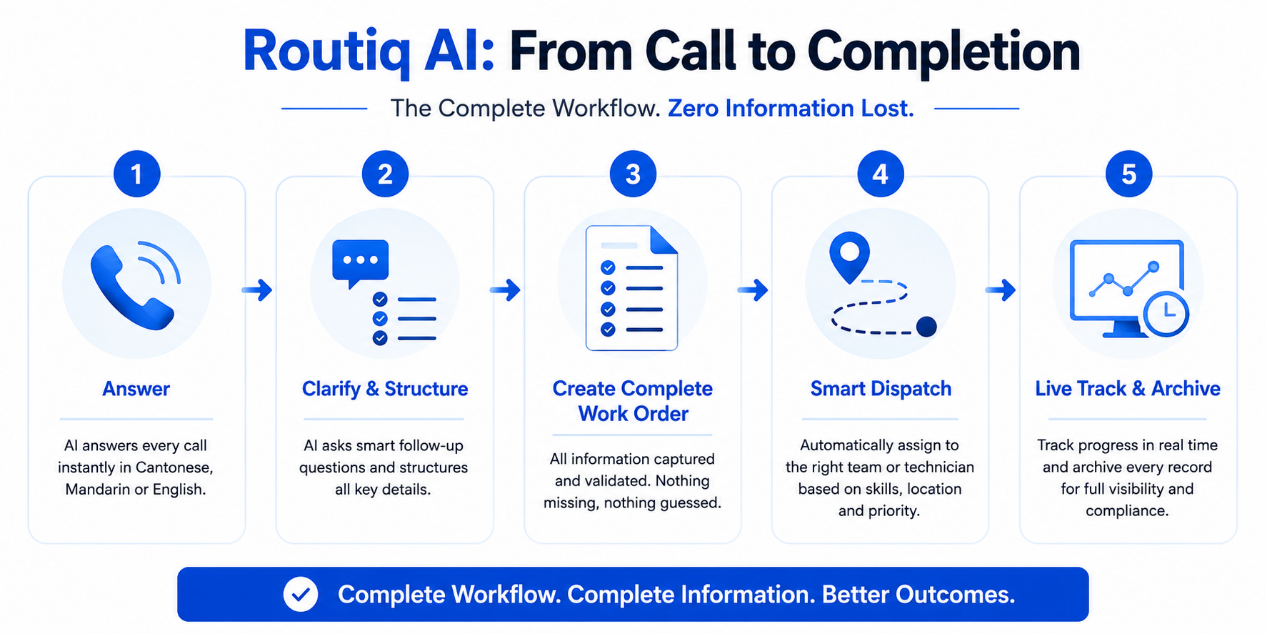
A third approach is to use a platform designed specifically for facilities and maintenance workflows. Routiq AI is one example of this category. These systems are built around the full process rather than call answering alone.
Instead of stopping at a transcript or a short note, the focus is on turning the conversation into structured operational information. In practice this means:
- Answering calls 24/7 in Cantonese, English and Mandarin, including natural code-switching
- Clarifying key details during the call (location, symptoms, urgency, access, safety)
- Creating a structured work order automatically
- Applying classification and priority rules
- Supporting dispatch with fuller context
- Giving operations teams clearer visibility
- Keeping a consistent record of what was reported and what followed
The aim is to reduce the information gaps that commonly appear between the initial report and the moment a technician arrives on site. This full-workflow approach (Answer → Create Work Order → Dispatch → Track → Archive) is the key practical difference from both self-developed tools that often remain incomplete, and traditional outsourcing that primarily solves the answering stage. For a wider view of how current AI call-centre solutions differ in scope, see the comparison of modern AI call centre approaches.
Comparison overview
| Aspect | Self-develop | Traditional outsource | Purpose-built platform |
|---|---|---|---|
| Time to get started | Longer | Relatively fast | Usually days to a few weeks |
| Handling of natural Cantonese | Requires significant work | Depends on agents | Designed for local speech patterns |
| Completeness of information | Variable | Often moderate | Core design focus |
| Structured work-order creation | Needs to be built | Rarely automatic | Standard capability |
| Live visibility | Only if developed | Often limited | Built-in |
| After-hours consistency | Depends on your resources | Variable | Designed for continuous coverage |
| Ongoing burden on internal team | High | Medium | Lower (system use and oversight) |
Practical considerations
- Self-develop suits organisations that have dedicated technical capacity, sufficient budget, and a clear plan to maintain the system long-term.
- Outsourcing remains practical when the main priority is call answering and a degree of variability in note quality is acceptable.
- A purpose-built platform becomes relevant when incomplete tickets, limited after-hours control, or lack of real-time visibility are recurring issues.
In many facility and maintenance environments, the biggest daily friction comes not from the technical difficulty of the repair itself, but from missing or unclear information at the start of the process. Improving the structure and completeness of that initial information tends to reduce coordination effort and support better first-time resolution — a point also explored when examining ways to reduce day-to-day operational workload.
Final thought
There is no single answer that fits every organisation. The more useful question is which part of the process is currently causing the most friction — answering the call, capturing the right details, getting the information to the right people, or maintaining visibility afterwards.
When the priority is to improve the quality of information that reaches technicians and to keep the process visible from the first report through to completion, a purpose-built approach such as Routiq AI offers a more complete response than building from scratch or relying only on traditional message-taking.
FAQ
Is outsourcing usually enough?
It works well when the main goal is to make sure calls are answered. If incomplete details are creating repeated visits or extra coordination, teams often look for ways to improve information quality at the source.
Why is building in-house challenging for many teams?
Reliable understanding of local spoken Cantonese, structured data extraction, and continuous maintenance of the full workflow often require more sustained effort than expected.
What does a purpose-built platform add beyond answering calls?
It focuses on turning the conversation into clearer, more complete information that can support work-order creation and dispatch, while giving managers better visibility across the process.
How quickly can it be used?
Many teams begin with core call types within a relatively short period, depending on integration needs.
What happens with complex calls?
The system can escalate to a human with the conversation context already captured, so the handoff remains informed.