
Summarize this article with AI(click one of the models and ctrl+v)





Why admissions season overwhelms school and university phone lines
Most of the year, a school or university enquiry line is manageable. Then the admissions cycle arrives, and the volume goes vertical. Kindergarten and primary application windows, secondary school allocation, JUPAS and DSE results day, university open days and clearing periods — each one sends a wave of calls into an office that's staffed for a normal Tuesday, not a flood.
The calls aren't random, either. They cluster tightly around a handful of moments and a handful of questions, which is both the problem and the opportunity. Like most service operations, education enquiries fall into predictable, repeatable patterns — just as the common property management calls an AI call centre can handle do — the same twenty questions asked a thousand different ways. A system that recognises those patterns can absorb the wave. A two-person admissions office cannot.
Anatomy of the calls: what parents and applicants actually ask
Walk the phones during an application window and the enquiries sort themselves into a few clear buckets. Parents ask about deadlines, required documents, fees and payment, transport and catchment, term dates, uniforms, and the status of an application already submitted. Applicants — especially at university level — ask about entry requirements, program details, offer conditions, and what to do on results day.
Most of these are answerable from information the institution already publishes. They don't need the admissions officer's judgement; they need a fast, accurate, patient answer at the exact moment the parent picks up the phone. The trouble is that "fast, accurate and patient" is precisely what a human team can't sustain during a spike — by the fiftieth identical call about the application deadline, the queue is long and the good enquiries are stuck behind the routine ones.
Where the front-office model breaks under load
The traditional front-office model has predictable failure points, and they all surface at the worst time:
- Staffing is fixed; demand is spiky. You can't hire a seasonal admissions team for three weeks of peak calls, so the existing staff simply drown.
- Routine calls block important ones. A parent with a genuine, complex admissions question waits on hold behind ten people asking what time the office opens.
- Overflow goes to voicemail — and voicemail goes unheard. During a spike, no one has time to work through a full voicemail box, so messages age and enquiries die.
- The work is repetitive and morale-draining. Answering the same question hundreds of times is exactly the kind of load an intelligent call layer is built to lift — it's a clear case of how AI reduces day-to-day workload for front-office teams.
The stakes: a missed admissions call is a lost enrolment
In most industries, a missed call is an annoyance. In admissions, it's a lost enrolment — and in a competitive Hong Kong market where families apply to several schools at once, the institution that answers first has a real advantage. A parent who reaches a warm, helpful line at 8pm forms a very different impression from one who hits a full voicemail box and moves on.
The financial logic is stark. A single enrolment can represent years of tuition, so even a small number of missed or abandoned enquiries during peak season carries a cost that dwarfs the price of never missing a call in the first place. The phone line isn't overhead during admissions; it's a revenue channel, and it's leaking exactly when it's fullest.
Answer → resolve → capture → route: the Cantonese AI workflow
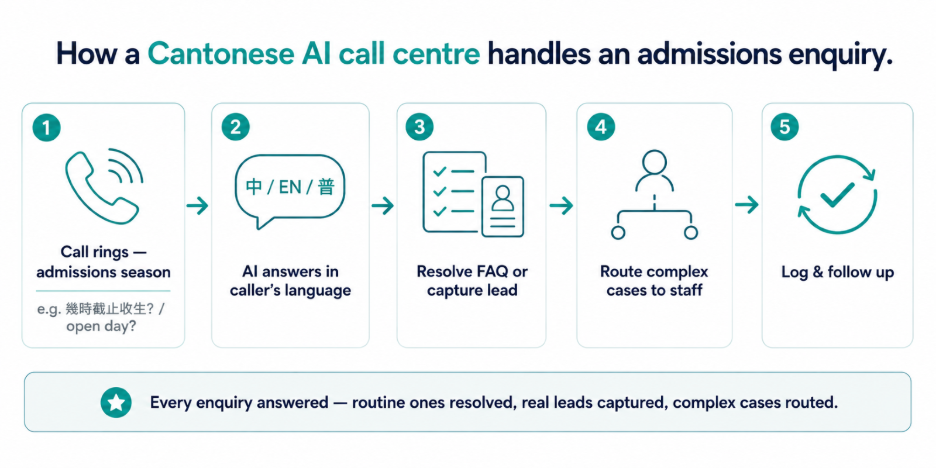
This is what a purpose-built Cantonese AI call center changes. Instead of a fixed team that buckles under the spike, every enquiry meets a system that's awake, consistent, and connected to your admissions process. The workflow runs as one clean sequence.
The AI answers on the first ring, 24/7, in the caller's language. It understands the parent or applicant even when they're switching between Cantonese, English and Mandarin, and even over a poor line. It resolves the routine questions directly from your published information. When the call is a genuine prospect, it captures the applicant's details and logs a structured lead. When the enquiry needs a human — a nuanced case, a complaint, a special circumstance — it routes it to the right person with full context. Choosing AI over an outsourced call centre matters here: an answering service only takes a message, while the AI actually resolves and records, rather than just relaying.
The FAQ layer: resolving repetitive enquiries end to end
The single biggest workload win in education is the FAQ layer — resolving the high-volume, low-complexity questions completely, so they never reach a human at all. Done properly, this isn't a phone tree that reads menu options; it's a system that understands a spoken, colloquial question and answers it directly from your institution's own information.
A rough map of how enquiries get handled looks like this:
| Enquiry type | Example questions | AI action |
|---|---|---|
| Routine information | Application deadline, office hours, required documents, term dates, fees | Answer directly from published info; no human needed |
| Prospect / lead | “My child is in K3, how do we apply for P1?” / program entry requirements | Answer, then capture applicant details and log a structured lead |
| Case-specific | Status of a submitted application, offer conditions, special circumstances | Route to the right admissions staff with full context |
| Sensitive / complex | Financial aid, special educational needs, complaints | Escalate to a named human handler promptly |
The reason this needs voice AI and not a website chatbot is simple: the anxious enquiries that matter most arrive as spoken phone calls, not typed messages. That's the same reason Hong Kong needs Cantonese voice AI, not just English chatbots — a parent worried about a deadline reaches for the phone, not a chat window.
Trilingual by design: Cantonese, Mandarin and English on one hotline
Hong Kong's education market is uniquely multilingual, and admissions lines feel it more than most. Local families call in fast, colloquial Cantonese. Mainland families call in Mandarin. International-school and expat families call in English. And plenty of parents move between all three inside a single sentence: 「喂,我想問下 primary one 嘅 application 幾時 deadline 呀?」 — when's the deadline for the P1 application?
A system built around one language at a time can't hold that. A capable Cantonese AI call centre is trilingual by design, expecting the mix rather than treating each language as a separate mode. And the accuracy stakes are real: Cantonese is tonal, so a mis-heard number can turn one year group or date into another — the difference between "4" (四, sei3) and "10" (十, sap6) is a single tone. Getting that right comes down to how Cantonese voice AI understands tones and code-switching, not a marketing checkbox — and on an admissions line, a wrong number is a wrong deadline given with full confidence.
Capturing real admissions leads — not just deflecting calls
Deflecting routine questions is only half the value. The other half is making sure every genuine prospect is captured — because answering the phone is where most systems stop, the exact reason call centres fail after the call ends.
When a caller is a real prospective family, a well-built system does more than answer their questions. It captures the child's year group, the program of interest, the parent's contact details and preferred follow-up, and logs a structured lead into your CRM or admissions system — timestamped and complete. Nothing sits in a voicemail box waiting to be transcribed by someone who's already overwhelmed. The admissions team opens their system the next morning to a clean, prioritised list of warm leads gathered overnight, each one ready for a personal follow-up. That's the difference between a phone line that merely survives the season and one that actively fills seats.
After-hours and peak-load: never miss a prospective family
Two conditions break human-only enquiry lines, and an AI call center is built precisely for both.
After-hours. Working parents research schools in the evening, on weekends, after the kids are down. That's exactly when your office is closed and your competitors' voicemail boxes are full. A system that answers warmly at 9pm captures the family that a voicemail would have lost.
Peak-load. Results day and application deadlines create call volumes that no fixed team can staff for. AI has no queue and no upper limit — the thousandth caller of the morning gets the same fast, patient answer as the first. The spike stops being a crisis to survive and becomes just another Tuesday for the phone line.
Data privacy and how to evaluate a system for education
Education handles sensitive personal data — children's details, family circumstances, application records — so privacy isn't optional. Any system you consider must handle personal data in line with Hong Kong's PDPO, keep a clear record of what was collected and why, and give you control over where that data lives and who can access it.
Beyond privacy, evaluate on the things that determine whether a system works for an admissions line:
- Built for Cantonese, not translated into it — tone-aware, trilingual by design, and hardened for real phone-line audio.
- It resolves and captures, it doesn't just message — answering routine questions and logging structured leads, not emailing you transcripts.
- Answers from your information — grounded in your institution's published details, so it doesn't improvise.
- Clean human escalation — a fast path to a named person for sensitive, complex or emotional cases.
- Integrates with your admissions stack — leads land in the CRM or system your team already uses.
For a broader view of how the leading platforms compare against each other, our guide to the best AI call centre solutions in 2026 walks through the evaluation criteria in detail.
The practical takeaway is straightforward. For a Hong Kong school or university, the enquiry line is a front door and a revenue channel at the same time — and it's under the most pressure at the exact moment it matters most. A Cantonese AI call centre exists so that door is always open, always answered, and always in the caller's own language.
Frequently asked questions
Can the AI answer detailed questions about our specific programs and fees?
Yes, when it's grounded in your institution's own published information. A well-built system answers from your admissions details, fee schedules and term dates rather than improvising, so parents get accurate answers and anything outside its knowledge is routed to a human.
Will it actually capture applicant details, or just deflect the call?
A purpose-built system does both. It resolves routine questions directly, and when a caller is a genuine prospect it captures the child's year group, program interest and parent contact details, logging a structured lead into your CRM — rather than simply ending the call or leaving a voicemail.
Can it handle Mandarin-speaking and English-speaking families as well as Cantonese?
Yes, if it's trilingual by design. Hong Kong admissions lines take calls in Cantonese, Mandarin and English — often mixed within a single sentence — so a capable system expects the mix and handles it smoothly, rather than treating each language as a separate mode.
Is it appropriate for sensitive enquiries like financial aid or special educational needs?
These should route to a human. A well-designed system recognises sensitive and complex cases and escalates them promptly to a named staff member with full context, rather than trying to handle them itself. The AI's job there is to make sure the call is answered and reaches the right person quickly.
Does it comply with privacy rules for student and parent data?
It should handle personal data in line with Hong Kong's PDPO, keep a clear record of what was collected and why, and give you control over data access and residency. Privacy handling is one of the first things to check during evaluation, especially for an institution collecting children's information.
What happens during results day or an application deadline spike?
This is where AI has the clearest edge. It has no queue and no upper limit, so the thousandth caller during a results-day rush gets the same fast, patient answer as the first — turning a volume spike that would overwhelm a human team into a normal load for the phone line.