Summarize this article with AI(click one of the models and ctrl+v)





PropTech is transforming how buildings are managed, but its impact goes far beyond smart sensors and connected infrastructure. As Hong Kong's property industry faces increasing operational complexity, technology is shifting from making buildings smarter to making property management operations more efficient.
Hong Kong's Property Industry: Why Property Management Has Never Been More Complex
To understand why PropTech matters, we first need to understand what makes Hong Kong different. Hong Kong is one of the most densely built cities in the world. Limited land availability has driven the city to build vertically for decades, resulting in thousands of high-rise residential estates, Grade A office towers, mixed-use developments, shopping centers, hotels, hospitals, and industrial facilities.
This density creates a level of operational complexity that few cities experience. A single property management company may oversee dozens or even hundreds of buildings. Each building has its own residents, visitors, contractors, equipment, maintenance schedules, regulatory requirements, and service standards.
Now, imagine what normal scenarios can possibly happen on a regular weekday. We often hear about residents reporting a leaking ceiling, a lift unexpectedly stopping operation, or a security guard reporting a malfunctioning access gate. Individually, these seem like routine incidents. Collectively, they represent hundreds, sometimes thousands of operational decisions that property management teams must coordinate every day.
Many of Hong Kong's buildings are aging, requiring more frequent maintenance and asset replacement. At the same time, tenant expectations continue to rise, shaped by digital-first experiences in industries like banking, e-commerce, and ride-hailing. People no longer expect to wait until the next business day for a response, they expect real-time updates and faster resolutions.
At the policy level, Hong Kong is also accelerating investment in artificial intelligence and digital transformation as part of its long-term economic strategy, reinforcing the broader shift toward technology-enabled operations across industries. In this day and age, managing buildings is no longer just about maintaining physical assets. It's about managing information, communication, and operational workflows at scale.
What Is Property Management?
When most people hear the term "property management," they think about fixing broken equipment or collecting rent. In reality, property management is far broader than that. Property management is the day-to-day operation, maintenance, and administration of a building throughout its lifecycle. Its goal is to ensure that a property remains safe, compliant, financially sustainable, and enjoyable for the people who use it.
Depending on the type of property, a management team may be responsible for:
- Preventive maintenance of lifts, electrical systems, plumbing, and HVAC equipment
- Cleaning and environmental hygiene
- Security operations and visitor management
- Contractor coordination
- Resident and tenant services
- Emergency incident response
- Regulatory compliance and safety inspections
- Energy management and sustainability initiatives
- Financial administration and vendor management
In other words, property managers don't simply maintain buildings. They coordinate an entire ecosystem of people, assets, processes, and services. This is why modern property management has become less about physical infrastructure and more about operational excellence. As portfolios grow larger, managing these workflows manually becomes increasingly difficult. This is exactly the reason why PropTech is the next phase of development in the property management industry.
What Is PropTech?
PropTech, short for Property Technology, refers to the use of digital technologies to improve how properties are designed, built, managed, bought, sold, and maintained. Think of PropTech as the digital transformation of the real estate industry. Just as FinTech modernized banking and HealthTech transformed healthcare, PropTech is redefining how buildings operate throughout their lifecycle.
People think that PropTech only refers to smart buildings, but it's so much more:
- Building Management Systems (BMS): Software that monitors and controls building equipment such as lighting, air conditioning, and electrical systems.
- Internet of Things (IoT) devices: Connected sensors that continuously collect real-time information about a building's performance.
- Predictive maintenance platforms: Systems that analyze equipment data to identify potential failures before they occur.
- Digital Twins: Virtual replicas of physical buildings used to simulate, monitor, and optimize operations.
- AI-powered analytics: Tools that help property managers make faster, data-driven decisions.
- Workflow automation platforms: Software that reduces repetitive administrative work.
Collectively, these technologies have transformed property management from a reactive industry into one that is increasingly proactive and data-driven. Hong Kong's PropTech ecosystem continues to grow as real estate companies adopt smart building technologies, AI-powered management platforms, and automation tools to improve operational efficiency, sustainability, and customer experience. Government initiatives supporting smart city development and digital transformation are also encouraging wider adoption across the sector.
But to understand where the industry is going next, we first need to understand how PropTech has evolved over time.
The Four Waves of PropTech: How Property Technology Has Evolved
Over the past two decades, the property industry has moved through four distinct waves of innovation. Each wave has fundamentally changed how buildings are managed while simultaneously exposing new operational challenges that the next generation of technology aims to solve. Understanding this evolution provides important context for why AI-powered operational tools are becoming increasingly relevant today.
Wave One: Digitizing Property Management
The first generation of PropTech focused on one objective: replacing paper.
Before the early 2000s, many property management companies relied on physical filing cabinets, handwritten maintenance records, spreadsheets, and phone calls to manage buildings. Finding historical maintenance records could take hours. Scheduling preventive maintenance depended heavily on manual calendars. Building information was often scattered across different departments.
The introduction of Property Management Systems (PMS) changed this.
Property Management Systems centralized information such as resident records, maintenance histories, financial reports, contracts, and vendor information into a single digital platform.
For the first time, property managers had one place to manage operational data. This marked the industry's transition from paper-based administration to digital property management. But while information became digital, buildings themselves were still largely disconnected.
Wave Two: Making Buildings Smart
The second wave focused on the building itself. This is the stage most people associate with PropTech today. Instead of simply storing information digitally, buildings began generating their own data. This became possible through the Internet of Things (IoT)—a network of connected sensors and devices capable of collecting and sharing real-time information.
- Sensors could detect temperature changes.
- Electricity consumption could be monitored remotely.
- Water leakage could trigger automated alerts.
- Smart access systems replaced physical keys.
- Elevators continuously transmitted performance data.
Many commercial buildings also adopted Building Management Systems (BMS)—centralized software platforms that monitor and control building services such as HVAC, lighting, ventilation, elevators, fire systems, and electrical equipment.
Rather than waiting for someone to notice a problem, buildings could now report their own operational status. For property managers, this represented a significant leap forward.
Wave Three: From Monitoring to Prediction
As buildings became increasingly connected, the industry accumulated enormous amounts of operational data. This vast amount of data gave rise to the third generation of PropTech. Instead of simply monitoring equipment, organizations began using artificial intelligence, cloud computing, and predictive analytics to anticipate future events.
One example is Predictive Maintenance. Rather than servicing equipment on a fixed schedule, predictive maintenance analyzes sensor data to estimate when an asset is likely to fail. For example, an air-conditioning system that begins consuming unusually high amounts of energy may indicate that a component is deteriorating. Instead of waiting for a breakdown—or replacing parts too early—maintenance teams can intervene at the optimal time.
Another important development is the Digital Twin. A Digital Twin is a virtual representation of a physical building that continuously updates using live operational data. Property managers can use Digital Twins to monitor building performance, simulate maintenance scenarios, and identify inefficiencies before they affect occupants. These technologies have helped property management become more proactive, reducing unexpected failures and improving asset performance.
The Operational Gap That PropTech Still Hasn't Solved
Imagine a resident notices water leaking through their ceiling. Even in a highly digitized building, the workflow often begins exactly the same way it did years ago, it's still highly dependent on humans. The building may be equipped with smart sensors, connected systems, and AI-powered dashboards.
Yet the operational workflow itself still depends heavily on people manually transferring information from one step to another.
This isn't unique to Hong Kong.
Across the global property industry, many organizations have successfully digitized assets but continue to rely on fragmented operational processes. Different teams often use different software. Maintenance requests may originate through phone calls, emails, messaging applications, or walk-in enquiries. Information must then be manually entered into property management systems before any work can begin. Each handoff introduces another opportunity for delays, inconsistencies, or human error. As portfolios expand and customer expectations continue to rise, these operational inefficiencies become increasingly difficult to manage.
The Five Operational Challenges Facing Property Managers Today
Although every property portfolio is different, several operational challenges consistently appear across the industry:
- Communication Remains Fragmented: Residents communicate through multiple different channels. Without a unified workflow, information becomes fragmented across different platforms, making it difficult to maintain consistent records.
- Every Maintenance Request Requires Manual Coordination: A maintenance issue rarely involves only one person. A typical request may require coordination between reception staff, property officers, engineering teams, external contractors, security personnel, and residents. Even relatively simple maintenance requests can involve multiple approvals and several rounds of communication before work begins.
- Service Expectations Continue to Increase: Residents increasingly expect the same responsiveness they experience in digital services such as food delivery, banking, or ride-hailing applications. They want immediate acknowledgment, continuous updates, and communication. Property management teams, however, often operate with limited staffing resources and fixed office hours. Meeting these expectations consistently is becoming increasingly challenging.
- Operational Data Exists—but Isn't Always Actionable: Most property management companies already collect large amounts of operational data. The challenge isn't collecting information; it's transforming that information into actionable insights. However, these insights are difficult to generate when operational data is incomplete or scattered across multiple systems.
- Administrative Work Consumes Valuable Time: One of the most overlooked costs in property management isn't maintenance itself—it's administration. These repetitive administrative tasks consume significant time that could otherwise be spent improving the resident experience or addressing more complex operational issues.
Fourth Wave: Autonomous Operations
Every previous generation of PropTech focused on making buildings smarter. The next generation is focused on making operations smarter. Instead of simply collecting information, modern AI systems are beginning to understand it, organize it, and act on it.
This shift marks the emergence of what many industry observers describe as autonomous operations—operational workflows where AI doesn't merely provide recommendations but actively assists in executing routine tasks within predefined business rules.
One example is the AI call center. Unlike traditional call centers that only answer incoming calls, AI call centers can understand conversations, extract key information, classify maintenance requests, generate structured work orders, trigger workflows, and route issues to the appropriate teams. In other words, they don't just improve communication, they transform communication into an operational workflow.
And that represents a fundamentally different way of thinking about PropTech. Instead of asking, "How can technology make our buildings smarter?" the industry is beginning to ask, "How can technology make our operations run themselves?" That question is shaping the next chapter of property management.
How AI Call Centres Fit Into the Future of PropTech
If the first three generations of PropTech focused on digitizing information, connecting buildings, and predicting problems, the fourth generation is focused on something different: Executing operational workflows.
Instead of simply collecting information, AI can now understand requests, make decisions based on predefined rules, and trigger the next step in an operational process. For property management companies, that changes the role of the phone call entirely. Instead of being the beginning of a manual process, it becomes the beginning of an automated one.
How an AI Call Centre Works
When people hear "AI call centre," they often imagine an automated voice reading from a script.
Modern AI systems are far more sophisticated. Today's AI call centres combine several technologies that work together behind the scenes.
- Speech Recognition
- The first step is converting spoken language into text. This process, known as Automatic Speech Recognition (ASR), allows AI to accurately transcribe conversations in real time. For Hong Kong's multilingual environment, this is particularly valuable, as many AI platforms can support Cantonese, Mandarin, and English within the same workflow.
- Natural Language Processing (NLP)
- Once a conversation has been transcribed, the AI needs to understand it. This is where Natural Language Processing (NLP) comes in. NLP enables computers to interpret human language by identifying intent, extracting key information, and understanding context.
- For example, if a resident says, "There's water leaking from the ceiling in Block B, Unit 1208." The AI can automatically identify: the issue (water leakage), the location (Block B, Unit 1208), the urgency (potential property damage), the caller's details (if integrated with resident records). So, Instead of relying on someone to manually capture these details, the information is structured automatically.
- Large Language Models (LLMs)
- Modern AI call centres are increasingly powered by Large Language Models, which can generate natural responses, summarize conversations, and adapt to a wide range of scenarios without needing to be scripted for every possible interaction.
Workflow Automation
Understanding the conversation is only the beginning, but the real value comes from what happens next.
Modern AI call centres can integrate with Property Management Systems (PMS), Computerized Maintenance Management Systems (CMMS), and other operational platforms to trigger automated workflows.
Instead of handing information from one person to another, the workflow progresses automatically. This is why AI call centres are increasingly viewed as an operational platform, not simply a communication tool.
- Traditional vs. AI-Powered Property Management Workflows.
- To understand the difference, let's compare a typical maintenance request.
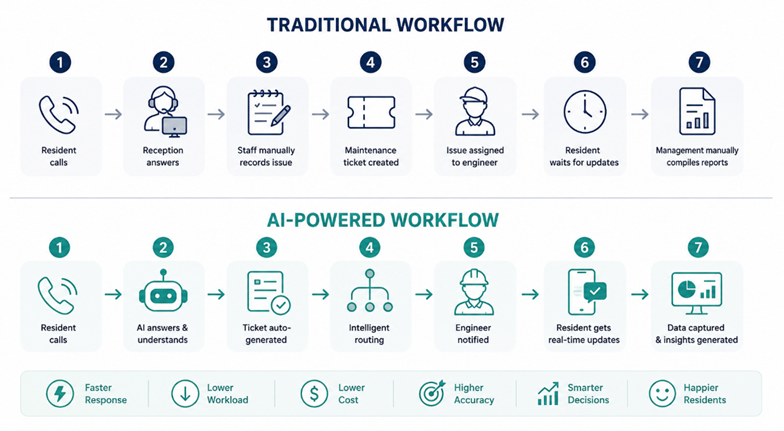
The objective isn't to remove people from the process.
It's to reduce repetitive administrative work so property teams can focus on higher-value activities such as resident engagement, preventive maintenance, and operational planning.
The industry's growing investment in AI and PropTech reflects a broader shift in how real estate organizations operate.
Several trends are driving this transformation:
- The global PropTech market is expected to continue expanding rapidly over the coming decade, driven by increasing investment in AI, cloud computing, IoT, and smart building technologies.
- AI adoption across commercial real estate is accelerating as organizations seek to improve operational efficiency, tenant experience, and data-driven decision-making.
- Hong Kong continues investing in artificial intelligence and smart city initiatives, with government funding supporting AI infrastructure, research, and digital transformation across multiple industries.
These trends point to a common conclusion. Technology investment is no longer focused solely on making buildings more intelligent. Increasingly, it is focused on making operations more efficient, connected, and autonomous.
The Future of PropTech
Looking ahead, the next chapter of PropTech is unlikely to be defined by a single technology. Instead, it will be shaped by how multiple technologies work together. Technology isn't simply monitoring the building; it's coordinating the entire operational response.
This concept is often referred to as autonomous operations—a model in which AI assists in carrying out routine operational workflows with minimal manual intervention. While the industry is still in the early stages of this transition, the direction is becoming increasingly clear. Buildings are becoming connected. Data is becoming actionable. Operations are becoming increasingly intelligent.
Key Takeaways
- The evolution of PropTech tells an important story.
- The first generation digitized information.
- The second connected buildings.
- The third introduced predictive intelligence.
- Now, the fourth generation is beginning to automate operations.
- For property management companies, this represents more than another technology trend. It reflects a fundamental shift in how buildings are operated.
- As portfolios become larger, resident expectations increase, and operational complexity grows, success will depend not only on having smarter buildings but also on having smarter workflows.
- AI call centres are one example of this evolution. They demonstrate how artificial intelligence can move beyond answering questions to supporting the operational processes that keep buildings running every day.
- Ultimately, the future of PropTech isn't just about creating intelligent buildings. It's about creating intelligent operations. And in a city as dynamic and densely built as Hong Kong, that shift may prove just as transformative as the smart building revolution itself.
FAQ
What is PropTech, and why is it important for property management in Hong Kong?
PropTech (Property Technology) refers to digital solutions that improve how buildings and facilities are managed. In Hong Kong, PropTech helps property management companies automate routine operations, improve communication with residents, streamline maintenance workflows, and enhance service quality. As labour shortages and resident expectations continue to rise, PropTech has become an essential investment for modern property management.
How do AI call centers improve property management operations?
AI call centers help property management companies answer calls 24/7, record maintenance requests, create work orders, dispatch engineers, and provide consistent responses to residents. By automating repetitive communication, AI reduces missed calls, shortens response times, and allows property managers to focus on higher-value operational tasks.
What are the benefits of using AI in property management?
AI improves property management by increasing operational efficiency, reducing manual administrative work, ensuring every resident enquiry is captured, and providing faster response times. It also helps standardise service quality, generate valuable operational data, and support better decision-making across property management teams.
Can AI replace property managers or customer service teams?
No. AI is designed to automate repetitive and high-volume tasks rather than replace people. Complex situations involving disputes, negotiations, legal issues, or resident relationships still require human expertise. The most effective property management operations combine AI automation with experienced property management professionals.
What is the future of PropTech and AI in Hong Kong's property management industry?
The future of PropTech in Hong Kong is expected to become increasingly AI-driven. Beyond handling resident enquiries, AI will help predict maintenance needs, automate workflows, coordinate service providers, analyse operational data, and support smarter building management. As these technologies mature, AI will become a core part of how modern property management companies improve efficiency and resident satisfaction.