
Summarize this article with AI(click one of the models and ctrl+v)





Why the clinic phone line is harder to manage than it looks
A busy GP clinic or specialist centre in Hong Kong fields dozens of inbound calls every day before the first patient is even seated. Bookings and cancellations, prescription refill requests, enquiries about fees and insurance coverage, results follow-ups, referral paperwork — each call is short in isolation and relentless in aggregate. The phone rings while the receptionist is checking in a patient, while a nurse is on another line, while the doctor is between consultations.
Healthcare adds a layer that makes mishandled calls genuinely consequential. A patient who cannot reach the clinic to check a symptom escalates the wrong way. A prescription enquiry answered incorrectly creates clinical risk. A referral that is not logged delays treatment. The stakes on accuracy and responsiveness are higher here than in almost any other vertical — yet call volume is still treated as an administrative problem rather than a clinical-quality one.
Like high-volume service operations in other sectors, clinic call traffic follows predictable, repeatable patterns an AI call centre is designed to handle. The difference in healthcare is that the cost of getting it wrong is not a missed booking — it is a patient outcome.
Anatomy of the calls: what patients actually ring about
- Appointment booking and rescheduling. The majority of inbound volume, answerable instantly from the live schedule.
- Prescription and medication enquiries. Refill requests, dosage timing, whether a prescription is ready for collection — accurate answers, with a clinical check where needed.
- Fees, insurance and payment. Consultation costs, accepted insurance panels, claim submission. High frequency, answerable from published information.
- Referral and results follow-up. Chasing a referral letter, asking when results will be ready, confirming a specialist appointment.
- General clinic information. Opening hours, location, parking, which doctor is available this week. Routine and completely automatable.
- Urgent or clinical calls. A symptom that needs same-day attention, or a caller in distress. These must be identified fast and routed to a clinical person without delay.
Where the front-desk model fails under patient call volume
The front desk is asked to do too many things at once — check patients in, handle payment, answer the phone, manage the waiting room, coordinate with doctors. The phone is the task that loses, and it loses in predictable ways.
- Calls ring out during peaks. Morning rush, post-lunch and end of day are exactly when patients want to book and when the desk is least able to answer.
- Patients on hold have a bad experience. Four minutes on hold about a symptom or a result forms a view of the practice before anyone speaks.
- Voicemail does not get worked through. A full mailbox at 6pm is a pile of callbacks the next morning — some to patients who have already booked elsewhere.
- Information is inconsistent. Different receptionists give slightly different answers on fees or insurance, so the patient's experience depends on who picks up.
These are the same structural failures that drive workload problems for operations teams across service sectors — and the fix is the same: a consistent, always-on layer that handles routine calls so the humans focus on the ones that need them.
The patient experience cost of a missed or delayed call
A missed call is not just a lost booking. It is a patient who did not get an answer at a moment when they were already anxious. A patient who cannot book delays care. A patient who cannot reach anyone about a result assumes the worst. A patient who feels ignored writes a review before they have seen the doctor. And a clinic known for being hard to reach quietly loses volume it never sees leaving.
The operational cost is just as real. Missed calls become callbacks, callbacks stack, and each one takes a receptionist off the floor. The work that accumulates after a call is often larger than the call volume itself — and it lands on the same stretched team.
Answer → resolve → route → log: the Cantonese AI workflow for healthcare
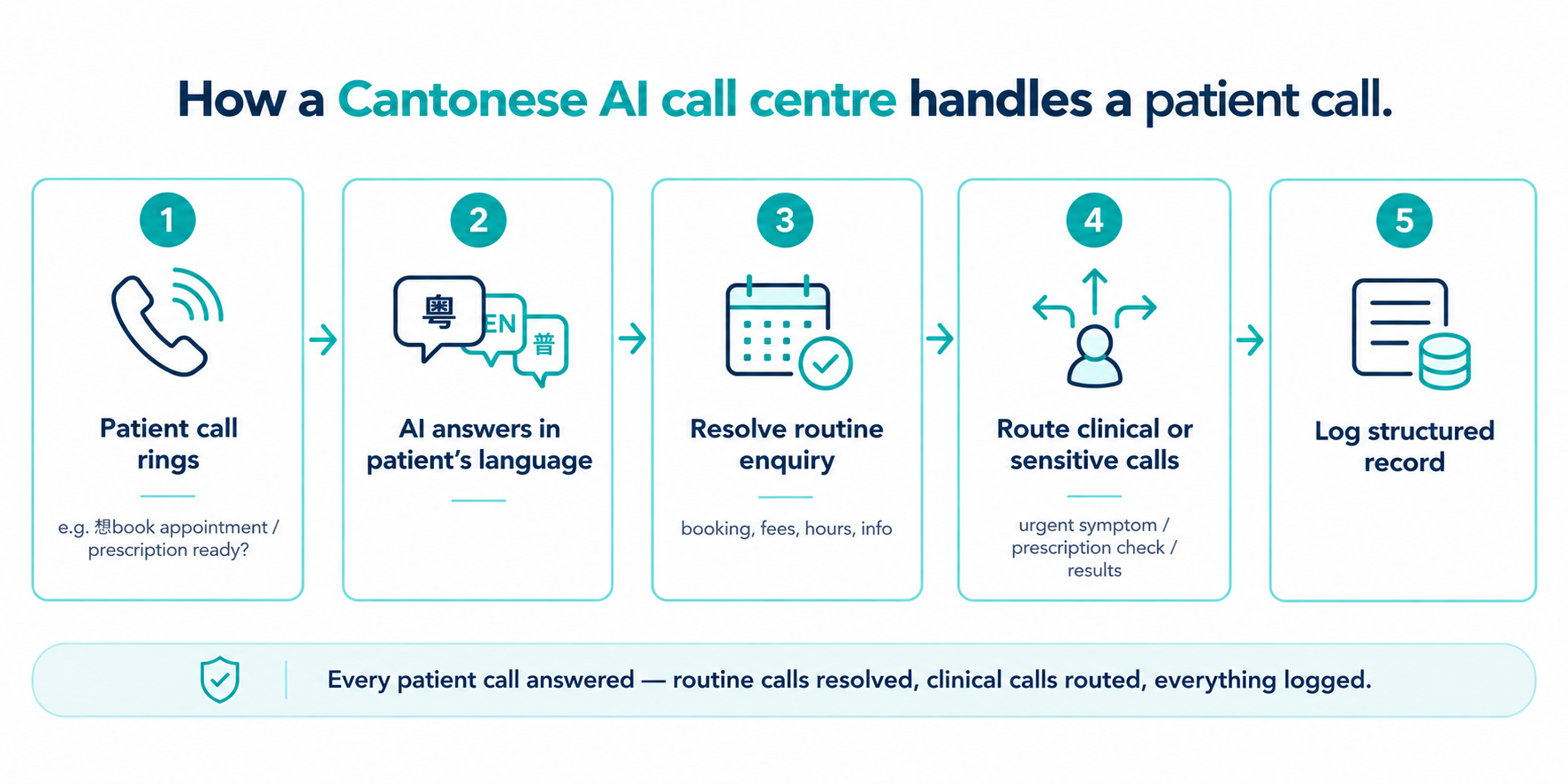
The AI answers on the first ring in natural Cantonese, Mandarin or English. It understands patients who mix languages, speak quickly, or use lay terms rather than clinical vocabulary. It handles routine calls — booking, rescheduling, fee enquiries, general information — end to end. When it recognises a prescription enquiry that needs clinical review, a referral chase that needs a coordinator, or an urgent symptom that needs a clinician, it routes the call immediately, with full context.
Unlike an answering service that simply takes a message, an AI-driven approach handles and routes rather than just relaying — so the patient gets a resolution or an appropriate handoff, not a promise that someone will call back.
Appointment booking and rescheduling: the highest-volume call type
Appointment calls are the majority of what a clinic line handles, and the category most suited to automation, because the logic is simple: check availability, take the patient's details, confirm the slot, update the schedule. No clinical judgment is involved. What is required is speed, accuracy and the patient's own language.
A connected Cantonese AI call centre books, reschedules and cancels directly in your practice management system, so the appointment exists in the right place the moment the call ends. The patient gets an immediate confirmation. The receptionist does not stop what they are doing. And the schedule is always current, because no booking sits on a sticky note.
The capacity this frees is real. A clinic handling fifty appointment calls a day, each taking three to four minutes of receptionist time, is spending three hours of front-desk capacity on a task the AI handles in thirty seconds per call.
Prescription, referral and insurance enquiries: accuracy under pressure
These three call types share one characteristic: an inaccurate answer has real consequences. A wrong answer about whether medication is ready sends a patient on a wasted trip. A wrong answer about coverage creates a billing dispute. A missed referral follow-up delays treatment.
The right design is not full automation — it is accurate resolution where the answer is straightforward, and fast routing with full context where clinical or administrative review is needed. Prescription readiness comes from your dispensary system. Insurance panel questions come from your current panel list. A results enquiry routes to the right clinical coordinator, with the patient's name, booking ID and the nature of the enquiry already passed across.
The discipline is the same as in every high-stakes service sector: the execution gap between knowing something needs to happen and making it happen is where patient experience is won or lost. Structured routing, not voicemail, closes that gap.
Routing clinical and sensitive calls: where the human stays essential
AI handles volume. Humans handle judgment. In healthcare that line matters more than in almost any other sector, and a well-built system is designed around it rather than around pushing the AI past it.
Calls that must route to a human immediately include any patient describing a symptom that suggests urgent or same-day care, any caller showing signs of distress, any prescription query requiring clinical review, and any patient who asks to speak to a doctor. The AI's role in these calls is not to handle them — it is to identify them fast, answer immediately so the patient is not left waiting, and put them in front of the right person with everything already said.
This design also protects the clinic. A system that tries to handle clinical calls it should not be handling creates liability. A system that routes them correctly — immediately, with context — makes the clinical team more effective, not less needed.
Cantonese, Mandarin and English: why language handling is a patient safety issue
A patient describing a symptom does it best in their own language. When the system they are speaking to mishears a tone, fails on code-switching, or drops the English medical term inside a Cantonese sentence, they either simplify what they are saying and lose clinical nuance, or they give up and hang up.
Real Hong Kong Cantonese is tonal, code-switched and full of English medical vocabulary inside Cantonese grammar: “我有少少 chest pain,係咪要今日見醫生?” A single mis-heard tone changes the clinical picture entirely. This is precisely why Cantonese voice AI built for Hong Kong handles calls English-first systems cannot — and in healthcare, the gap between a system built for the dialect and one translated into it is a patient-safety distinction, not a feature one. The technical reasons behind that gap are what make Cantonese speech recognition genuinely hard to get right.
What to look for when evaluating a healthcare AI call centre
- Cantonese-native, not Cantonese-labelled — tone-aware, trilingual by design, and able to handle patient speech as it actually sounds: fast, informal, code-switched, over a mobile line.
- Practice management system integration — bookings should write directly to your PMS or scheduling system, not create a parallel record.
- Configurable clinical routing — you define what goes to a clinician and what the AI resolves, matching your protocols rather than a generic template.
- Accurate resolution from your own data — fee, panel and hours questions answered from live information, not a static script that goes stale.
- A clear human escalation path — any call touching clinical urgency or patient distress goes to a person immediately, with no gap and no further routing steps.
- Data privacy and PDPO compliance — patient data handled in line with the Personal Data (Privacy) Ordinance, with clear data residency, access controls and a record of what was collected and why.
For a full breakdown of how leading platforms compare against these criteria, our guide to the best AI call centre solutions for Hong Kong in 2026 covers the evaluation framework in detail.
The practical takeaway for any clinic or healthcare provider is this: patients judge a practice before they walk in, based on whether someone answered the phone. A Cantonese AI call centre exists so the answer is always yes — immediately, in the patient's language, with the right resolution or the right human at the other end.
FAQ
Can the AI actually book appointments directly into our scheduling system?
Yes, when integrated with your practice management system. The AI checks live availability, takes the patient's details and preferred time, confirms the booking, and writes it directly to your schedule — so no appointment sits on a notepad waiting to be entered, and the patient gets an immediate confirmation.
How does it know when to route a call to a clinician rather than handle it?
Routing logic is configurable to your clinical protocols. You define which call types escalate — urgent symptoms, prescription queries requiring clinical review, results follow-ups, any patient who asks to speak to a doctor — and the AI routes those immediately, passing everything the patient has already said to the person taking over.
Is it appropriate for sensitive patient conversations?
The AI handles the intake and routes; the human handles the sensitivity. For calls involving distress, clinical urgency, or anything the patient wants to discuss with a clinician, the system's job is to identify the call quickly and get it to the right person fast — not to attempt to manage it alone.
How does it handle patients who mix Cantonese, Mandarin and English?
A trilingual-by-design system expects and handles that mix as standard. Hong Kong patients routinely use English medical terms inside Cantonese sentences, and a system built for the dialect handles code-switching without failing when the language shifts mid-sentence.
Does it comply with Hong Kong data privacy requirements for patient data?
Any system used in a healthcare setting must handle personal data in line with the Personal Data (Privacy) Ordinance, with clear data residency, access controls and an audit record of what was collected and why. Data handling is one of the first criteria to verify during evaluation.
What happens to calls that come in after hours?
Routine calls — booking, general enquiries, fee questions — are handled normally by the AI. Urgent clinical calls are escalated to an on-call clinician or emergency routing, depending on how you configure the system. Patients are never left with a ringing line or a voicemail for a call that needs a response.