
Summarize this article with AI(click one of the models and ctrl+v)





Why public service phone lines face a problem no commercial operator does
A restaurant that can't answer its phone loses a booking. A government office that can't answer its phone fails a civic obligation. The two are not comparable — and that asymmetry is what makes public service call handling uniquely hard.
Government hotlines must serve every caller, regardless of language, digital literacy, age, or the complexity of their situation. They cannot offer a chatbot as the only option when many callers are elderly, prefer voice, or can only explain their situation by speaking. They cannot accept that some calls simply won't be answered. And the cost of a poor experience is measured not in lost revenue but in public trust.
At the same time, public sector operations face the same resource constraints as any organisation. Adding headcount is slow, expensive and politically difficult. The result is a structural gap: high obligation, fixed capacity, and a caller experience that chronically underdelivers.
The call types driving that volume are not exotic. Like every high-volume service operation, government enquiry lines follow the predictable, repeatable patterns that AI call handling is built for. The difference is that in a public service context, resolving them consistently and accessibly is not a commercial choice — it is the mandate.
Anatomy of the calls: what citizens actually ring government offices about
- Status enquiries. Where is my application? Has my licence been approved? High in volume, answerable from case records, and deeply frustrating to wait on hold for.
- Appointment booking and rescheduling. Booking a visit, an inspection, or time with a case officer. Routine, schedulable and suited to automation.
- Fees, payments and deadlines. How much do I owe? When is the renewal deadline? How do I pay? Information calls that should never need a human agent.
- Forms and document guidance. Which form, which documents, where to submit. Answerable from published information — callers ring because they couldn't find or understand it online.
- Complaints and feedback. Reporting a problem, disputing a decision, escalating an unresolved case. These need a human and must be identified and routed quickly.
- Utility and infrastructure enquiries. Outages, bills and maintenance visits for water, power, waste and transport. High volume, highly repetitive.
Where the traditional hotline model breaks
The conventional public hotline runs on a queue and a bank of agents, and it fails in four consistent ways:
- Hold times are a public complaint, not a business metric. Twenty minutes on hold to ask about an application is a daily erosion of public confidence.
- Peak loads are structural. Licence renewals, tax filings and grant windows create predictable spikes a fixed agent pool cannot absorb. Callers give up; applications are late.
- Frontline agents spend most of their time on low-complexity calls. Status checks and fee enquiries crowd out the calls that actually need a trained officer.
- There is no consistent record of what callers asked or were told. When a citizen disputes advice, or a department audits response quality, there is no trail.
These failures mirror what drives poor performance in private-sector service operations — and the same AI-driven approach that reduces operational workload across facility and property teams applies directly to public services.
The public cost of a slow or unanswered citizen call
In the public sector, the cost of a missed call does not stay internal. A citizen who cannot get through escalates — to a district councillor, to social media — or misses a deadline with real consequences for a licence, benefit or case. The reputational cost falls on the agency; the practical cost falls on the citizen.
There is also a cascade effect. A caller without a status update rings back twice. A complaint not routed correctly becomes a formal submission. The unresolved work that stacks up when a call isn't handled at the point of contact multiplies the original volume. AI call handling is most powerful here: it resolves at first contact, eliminating the repeat call and the follow-on work.
Answer → resolve → route → log: the Cantonese AI workflow for public services
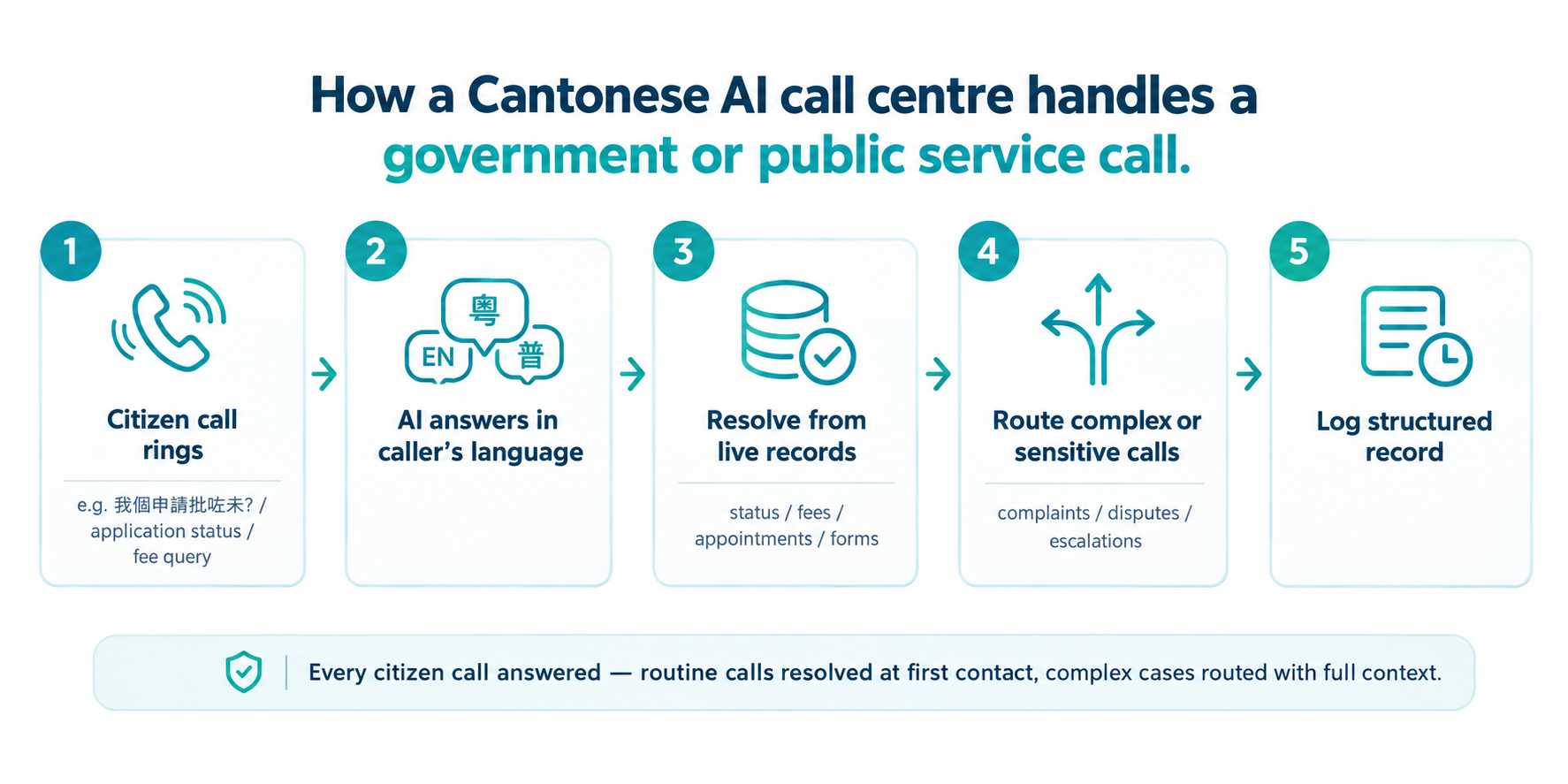
A Cantonese AI call centre built for public services works as a first-contact resolution layer in front of your existing team — absorbing the routine, routing the complex, and logging everything.
The AI answers on the first ring, in the caller's language, 24/7. It identifies the enquiry and handles straightforward calls — status checks from live case records, fee information, appointment bookings, form guidance — end to end. Anything requiring human judgment, discretion or authority — a complaint, a disputed decision, a sensitive case — is routed immediately to the right team with full context. Every call is timestamped and logged as structured data.
The contrast with outsourcing is significant. AI-driven call resolution and outsourced message-taking are different categories of service: one resolves and records at the point of contact; the other relays a message and creates a second round of work. For a public body accountable for every interaction, the audit trail alone makes the difference material.
High-volume routine enquiries: where AI eliminates the backlog
The single largest lever in a public service call operation is first-contact resolution of routine enquiries. Status checks, fee questions, deadline reminders and form guidance make up the majority of inbound volume in almost every government office — and none of them need a human agent. They need accurate information, delivered immediately, in the caller's language.
A connected Cantonese AI call centre answers these from your live systems. An application status is read from the case record. A fee is drawn from the current schedule. An appointment is booked directly into the office calendar. The caller gets an answer in thirty seconds, the agent pool is freed for the calls that need it, and the backlog never accumulates.
Application status, appointments and case follow-up
Application status. A citizen who applied for a licence, permit, grant or housing placement will ring to check progress. The routine check is answerable from a case record. When it does need an agent, it is because the case has stalled — exactly when the caller is most anxious and most deserving of a real person. Resolving routine checks with AI frees agents for the escalations, not the other way around.
Appointment booking. Offices requiring in-person visits — biometric registration, document submission, inspection, interview — generate appointment calls in high volume. Check availability, take the citizen's details, confirm the slot, log it. The AI handles this end to end, 24/7, without the citizen queuing on hold for the privilege of booking a time to queue in person.
Multilingual access: serving every Hong Kong resident on one line
A government hotline must be reachable by an elderly Cantonese-speaking resident in Sham Shui Po, a Mandarin-speaking new arrival in Tuen Mun, and an English-speaking expatriate in Central — on the same number, with the same quality of service. This is not a feature; it is a public duty.
Real Hong Kong Cantonese is tonal, fast and code-switched. A caller might say: “喂,我想問下我個 licence renewal 批咗未,我上個月 submit 咗 form 㗎。” — Hi, has my licence renewal been approved? I submitted the form last month. A system built around one language at a time cannot hold that.
This is precisely why a Cantonese-first voice AI is needed, not an English chatbot with a Cantonese option — and getting Cantonese speech recognition right means solving for tones, code-switching and real telephone audio in ways English-first systems were never built to do.
Complaints, escalations and sensitive calls: keeping the human where it matters
Not every citizen call should be resolved by AI. Calls that must route to a human include formal complaints, disputes over a decision or penalty, sensitive welfare or social services enquiries, and any situation where the citizen is distressed or asks for an officer.
For these calls, the AI's role is recognition and routing — not resolution. It identifies the call quickly, acknowledges the citizen warmly, and puts the call in front of the right team with everything already said passed across. The officer picks up informed; the citizen doesn't repeat themselves; the interaction is logged from first contact.
This matters for accountability. Just as a smart-building operation needs a closed loop from fault detection to resolved action, a public service needs a closed loop from citizen contact to documented outcome — across both AI-handled and human-handled calls.
What to look for when evaluating a Cantonese AI call centre for government use
- Cantonese-native, not Cantonese-labelled — tone-aware, trilingual, and built for how Hong Kong residents actually speak, not a lab demo.
- Live system integration — answers from your actual case records, schedules and fee data, not a static FAQ that goes stale.
- Configurable routing by department and case type — matching your internal structure, not a generic template.
- Full audit trail — timestamp, caller, enquiry type, response, routing decision and outcome for every call.
- PDPO and data residency compliance — citizen data handled under the Personal Data (Privacy) Ordinance, with clear storage, access and retention controls.
- Accessible design — works for elderly callers, non-native speakers and people with limited digital literacy.
For a detailed comparison against these criteria, see our guide to the top AI call centre platforms in Hong Kong in 2026.
The case for Cantonese AI in public services rests on the mandate rather than the business case. A government office that cannot answer its phones is failing the people it exists to serve. An always-on, always-in-Cantonese, first-contact resolution layer is the infrastructure a modern public service line should have been built on.
FAQ
Can AI handle the volume spikes that hit government lines during deadline periods?
Yes — this is one of its clearest advantages. Unlike a fixed agent pool, an AI call centre handles concurrent calls without queuing, so a peak created by a licence renewal deadline or grant application window is absorbed rather than creating a backlog. Every caller gets the same response on the first ring, whether it's a quiet Tuesday or the last day of the submission window.
Can it answer questions from live case records, not just static FAQs?
When integrated with your case management system, yes. Application status, processing stage and outstanding fees are read from live records, so the answer is current rather than a generic script. Static FAQ responses are the minimum; live-record integration is what makes it genuinely useful for a government service.
How does it serve elderly or less digitally literate callers?
The system is voice-first and phone-based — exactly the channel elderly and less digitally literate callers already use. They don't need an app, a chatbot or a website. They call the number they already have, speak naturally, and get an answer.
Is it compliant with Hong Kong data privacy requirements?
Any platform deployed in a public service context must comply with the Personal Data (Privacy) Ordinance, with clear data residency, access controls and retention policies. These requirements should be verified and documented before deployment — not assumed from a vendor's marketing.
Can it handle complaints and sensitive citizen calls appropriately?
The AI identifies complaints and sensitive calls and routes them to a human officer immediately, with full context. It does not attempt to resolve formal complaints, disputes or welfare enquiries on its own — the officer receives everything the citizen has said from the moment the call connected.
What about calls in Mandarin or English from non-Cantonese-speaking residents?
A trilingual-by-design system handles Cantonese, Mandarin and English on the same line, including the code-switching that is standard in Hong Kong speech. Every resident reaches the same number and receives the same quality of response in their own language.