Summarize this article with AI(click one of the models and ctrl+v)





Why after-hours breakdown calls are the hardest shift in facility & engineering
Facility and engineering teams run on predictability. Planned preventive maintenance, scheduled inspections, statutory checks — the daytime workload is largely a roster you control. Breakdowns are the opposite. They're unplanned by definition, and the worst of them cluster in exactly the hours when the office is empty: a standby generator that won't pick up load during a typhoon signal, a fire pump fault flagged at midnight, a fresh-water pump failing on a Sunday.
These calls carry real weight — life safety, asset damage, and SLA penalties that a facilities contract measures in minutes, not days. Hong Kong has poured investment into sensors, BMS dashboards and smart-building tech, but detection was never the bottleneck. The real friction sits in the gap between spotting a fault and actually getting it fixed — and that gap is widest at 2am.
Anatomy of a breakdown call today: from ring to (eventual) repair
A security guard, duty officer or tenant calls the management office line. It rings out or hits voicemail. They try the on-call engineer's personal mobile. Maybe he answers; maybe he's asleep and calls back twenty minutes later. He takes the details verbally — no ticket, no record — and decides whether to attend himself or ring a subcontractor. The subcontractor gets a hurried voice note with half the information: no floor number, no asset tag, no clear description of the fault. He arrives with the wrong parts. A second trip is booked for the morning.
The information degrades at every handoff. And these calls are rarely exotic — most inbound calls follow a small set of predictable patterns. The problem isn't that the calls are unknowable. It's that the system catching them is a single person and a personal phone.
Where the on-call rota model quietly breaks
- Single point of failure. One phone, one person. If that engineer is on another line, driving, or simply asleep, the emergency waits.
- No record when a call is missed. A ring-out at 3am leaves no trace. You find out at the morning handover — or when the client calls to ask why nobody responded.
- Cost and burnout. Paying engineers to be reachable overnight is expensive, and the churn it drives is worse. The overnight desk is the first thing that suffers.
- Inconsistent triage. Whether a fault gets treated as urgent depends entirely on who picks up and how awake they are.
That overnight burden is precisely where an intelligent call layer earns its keep — it's one of the clearest places operations teams see workload drop and ROI appear.
The four things that go wrong when a call lands at 2am
- The call is missed entirely. Voicemail or a ring-out means an emergency is now sitting unanswered — the single worst outcome, and the hardest to defend to a client.
- It's answered but never logged. A verbal handover with no ticket means no audit trail, no timestamp, and no way to prove response time when a penalty dispute lands later.
- It's triaged wrong. A non-urgent drip gets an expensive midnight callout, or a genuine emergency gets deferred to the morning because the details didn't land clearly.
- It's dispatched with bad information. The wrong trade, the wrong parts, no access details — a repeat visit, a wasted callout fee, and a fault that stays live for hours longer than it needed to.
Three of these four happen after someone picks up the phone. Answering is only the first step; the value is in what happens next.
Answer → triage → dispatch: the Cantonese AI workflow
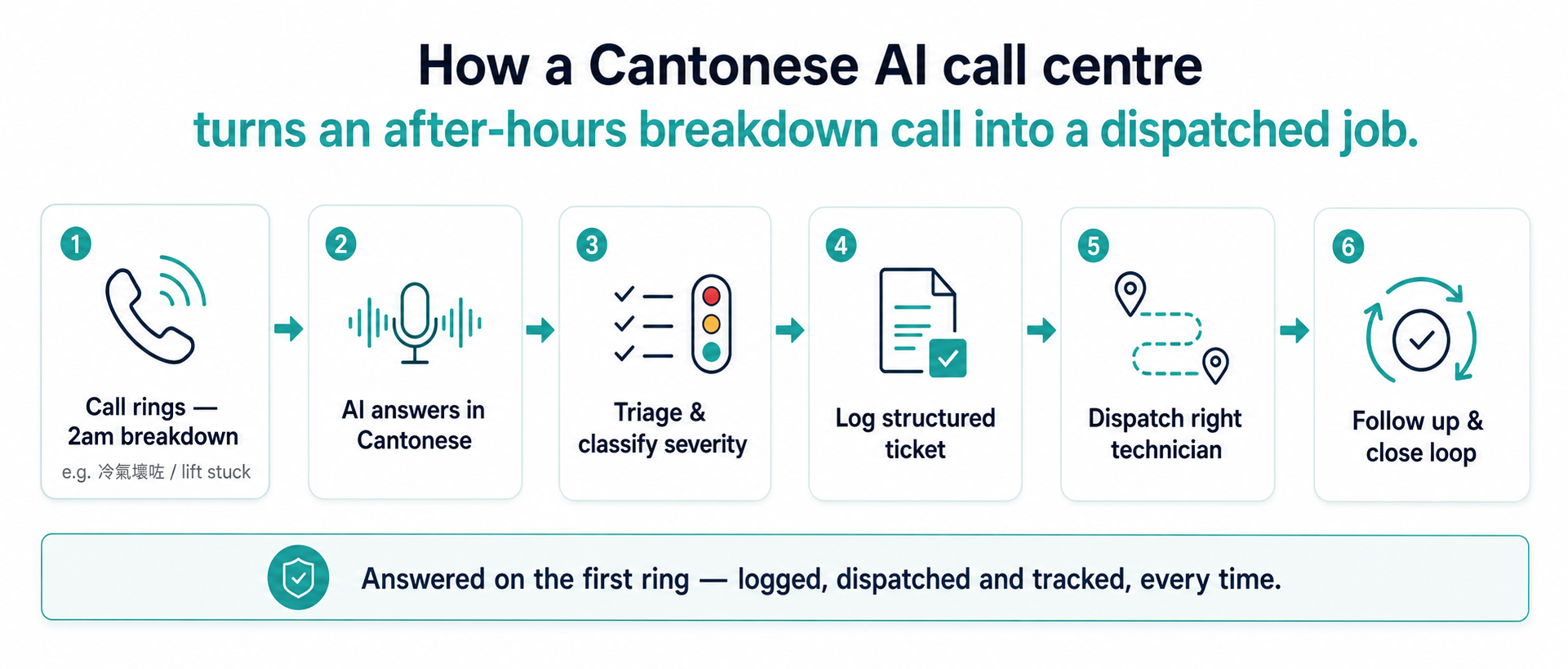
Instead of a rota and a personal mobile, every breakdown call hits a system that's awake, consistent, and connected to your dispatch tools. The AI answers on the first ring, 24/7, in natural Hong Kong Cantonese. It understands the caller even when they're switching between Cantonese, English and Mandarin mid-sentence, and even over a poor mobile line. It asks structured triage questions to pin down the fault, the location and the severity. It correctly parses what the caller actually said — not a rough approximation of it. It creates a categorised ticket in your system, matches the job to the right on-call resource, and sends a dispatch with full context. Then it confirms the technician has accepted, and follows up until the loop is closed.
Severity triage: telling a true emergency from a can-wait
The single most valuable thing an after-hours system does is decide how urgent a call is — because that decision drives cost and safety in opposite directions. Send a technician to every drip and you burn callout fees all night. Defer a real emergency and you have a liability event.
| Priority | Examples in facility & engineering | AI action |
|---|---|---|
| P1 — Life safety / critical | Lift entrapment, gas smell, fire-system fault, total power loss, active flooding | Dispatch immediately and escalate to a human on-call manager |
| P2 — Urgent asset / comfort | Chiller or HVAC down, significant water leak, partial power failure, escalator stopped | Log and dispatch within the contracted SLA window |
| P3 — Routine | Flickering light, minor drip, single faulty fixture, noise complaint | Log a ticket, schedule for the next working day, confirm with caller |
Two design principles matter here. First, the AI asks clarifying questions before it classifies — “係咪有人困喺𨋢入面?” (is anyone trapped inside the lift?) changes a P2 into a P1 instantly. Second, when the situation is ambiguous, it errs toward escalation rather than deferral. A system built for facilities should never quietly downgrade a call it isn't sure about.
Smart dispatch: the right technician, with the right information
Triage tells you whether to send someone. Dispatch decides who, and with what. This is where an AI call centre pulls decisively ahead of an answering service — because an answering service simply takes a message and hangs up, leaving the routing to a human who may not read it for hours.
The right technician — matched by trade (electrical, mechanical, plumbing, lift/escalator), by site or zone, by on-call availability, and where it matters, by certification. A lift fault needs a registered lift contractor; an electrical fault needs a registered electrical worker. The system routes accordingly instead of waking the nearest person and hoping.
The right information — the dispatch that reaches the technician isn't “call the office.” It's a structured job: exact location and floor, the asset involved, a clear fault description, the assigned priority, access notes, and any photos the caller was able to send. That's the difference between a first-time fix and the repeat visit that quietly doubles your cost per job.
Closing the loop: tickets, follow-up, and the SLA audit trail
Answering the call is where most systems stop. It's also where facilities operations lose the most — because the value isn't in the conversation, it's in everything that has to happen after the call connects.
A closed-loop AI call centre carries every breakdown through its full lifecycle: logged → dispatched → accepted → on site → resolved → closed, each stage timestamped. If the assigned technician doesn't acknowledge the job, the system chases and, if needed, re-routes or escalates. The caller gets an update rather than silence. And critically, the whole thing becomes an audit trail — response times you can prove, and a paper trail that settles SLA and penalty disputes instead of relying on someone's memory of a 3am phone call. For government, healthcare and education contracts where documentation is contractual, that record isn't a nicety; it's the deliverable.
Why Cantonese-native handling is non-negotiable for FES calls
The people who call after hours are rarely engineers. They're security guards, duty officers and tenants, describing a fault they don't have the vocabulary for, quickly, under stress. Their Cantonese is fast and colloquial, and it's saturated with code-switching: “個 pump 唔 work 呀,B1 停車場水浸緊,quick 啲 send 人嚟啦。” The pump isn't working, the B1 car park is flooding, send someone quickly. English technical terms — lift, chiller, genset, AHU, pump — sit inside Cantonese grammar as a matter of course.
Add the physical conditions: a plant room, a windy podium, a noisy lobby intercom, one bar of mobile signal. And add the tone problem, which turns location errors into dispatch errors — the difference between the 4th floor (四) and the 10th (十) is a single tone, and an English-first system that treats pitch as emotion will get it wrong with full confidence.
A generic voice bot with a Cantonese label bolted on collapses under all of this. This is exactly why spoken emergencies need voice-first Cantonese AI rather than an English chatbot: the dialect isn't a setting you toggle on, it's the foundation the whole system has to be built on.
How to evaluate a Cantonese AI call centre for your operation
- Built for Cantonese, not translated into it — trained on real spoken Hong Kong Cantonese, tone-aware, trilingual by design, and hardened for telephone audio.
- It dispatches, it doesn't just message — the system creates a structured job and routes it, rather than emailing you a transcript.
- Configurable severity logic — you set the P1/P2/P3 rules and the escalation thresholds for your contracts.
- Integrates with your stack — connects to your CAFM / CMMS / work-order system so tickets land where your team already works.
- A complete audit trail — timestamps across the full lifecycle, exportable for SLA and compliance evidence.
- Human escalation for life-safety — an unambiguous path to a person for P1 events, always.
For a wider view of how the leading systems stack up against each other, our full framework for comparing AI call centre platforms walks through the evaluation criteria in detail.
In facility and engineering services, the breakdown call is the moment your whole operation is judged — and it almost always arrives at the worst possible hour, in the messiest possible Cantonese, from someone who just needs the problem to go to the right person. A Cantonese AI call centre exists so that it does, every single time.
Frequently asked questions
Can AI actually dispatch a technician, or does it just take a message?
A purpose-built AI call centre dispatches. It creates a structured, categorised ticket and routes the job to the right on-call resource based on trade, zone and availability — then follows up on acceptance. That's the core difference between it and a traditional answering service, which only records a message and leaves the routing to a human.
How does the AI know which breakdowns are true emergencies?
It classifies each call against severity rules you configure, using both the caller's words and structured follow-up questions. Asking whether anyone is trapped in a lift, or whether water is actively flowing, can move a call from urgent to critical in seconds. When a situation is ambiguous, a well-designed system escalates rather than defers.
What happens if the AI can't handle a call?
For life-safety events and anything outside its confidence, it escalates to a human on-call manager immediately. The goal isn't to remove people from emergencies — it's to make sure every call is answered, triaged and routed the moment it comes in, with a person looped in exactly when one is needed.
Does it integrate with our existing work-order or CAFM system?
A capable platform connects to your CMMS / CAFM and dispatch tools so tickets appear where your team already works, with the full lifecycle tracked. Integration is one of the first things to check during evaluation, because a system that can't write into your stack just creates a second place to look.
Can it handle the technical Cantonese and code-switching our callers actually use?
That's the whole point of a Cantonese-native system. After-hours callers speak fast, colloquial Cantonese laced with English technical terms — “個 pump 唔 work”, “lift 壞咗” — over noisy lines. A system built for the dialect expects that mix and handles it in stride, rather than choking the moment a language switches mid-sentence.
Is it reliable enough for life-safety issues like lift entrapment?
For P1 life-safety events, the correct design is immediate dispatch plus human escalation — the AI never becomes a single point of failure for critical calls. It ensures the call is answered and actioned instantly, and pulls a person in at the same time, rather than leaving a life-safety event ringing out to voicemail.
This article is part of the Routiq AI series on AI call centres for facility, engineering and property operations in Hong Kong. For a wider view, explore how AI is reshaping day-to-day property operations in Hong Kong.