Summarize this article with AI(click one of the models and ctrl+v)





Why the fault call is the most important call you take
Every equipment service company runs on the same engine: a customer has a problem, they call, a technician is dispatched, the job is done. The fault call is the ignition. If it is missed, mishandled or misfiled, nothing else in the chain fires correctly — not the dispatch, not the job record, not the invoice, and not the SLA clock that started the moment the fault was reported.
What makes this harder than it looks is timing. Faults do not observe business hours. A lift tripping on a Saturday night, a commercial chiller failing before a Monday morning kitchen open, a fire suppression fault flagged by a building management system at 3am — these are the calls that define a service company's reputation. They are also the calls most likely to land in a gap: after hours, during a busy patch, when the one coordinator on duty is already managing two other callouts.
The challenge is rarely variety. Most fault calls follow a repeating set of scenarios an AI call centre is built to handle. The challenge is throughput and timing.
Anatomy of the calls: faults, service, warranties and enquiries
Sit on an equipment service line for a day and the calls sort into four distinct streams.
- Fault and breakdown reports. The core call: equipment has failed or is performing below spec and a technician is needed. Time-sensitive and commercially significant — every hour of downtime is an SLA breach or a reputational cost.
- Scheduled service and maintenance requests. A customer books a routine visit or flags a statutory inspection that is due. Less urgent, high in volume, easy to mishandle if the booking lands in the wrong place.
- Warranty and contract enquiries. Is this fault covered? When does the contract renew? What does the SLA guarantee? These need an accurate answer from the customer's contract record.
- Parts and return enquiries. When will the part arrive; when is the repaired unit coming back? Status calls: answerable from live information, frequent, low in complexity.
Each stream is answerable and none of it requires improvisation. The problem is volume, timing and the precision required — especially on the fault call, where getting the asset details wrong sends the wrong technician with the wrong parts.
Where the coordinator model breaks
Most equipment service companies run on a coordinator: one or two people who take fault calls, decide urgency, assign a technician and log the job. The model works at low volume. Under real operating conditions it has four structural failure points.
| Failure point | What happens | Operational impact |
|---|---|---|
| Single point of failure | Coordinator on another call or off shift | A 7pm fault is not actioned until 8am |
| Information loss at intake | Asset, location and fault written by hand under pressure | Wrong technician, wrong parts, second callout |
| Inconsistent triage | Urgency judged differently by whoever answers | Emergencies deferred, routine jobs treated as callouts |
| No audit trail | Verbal handover, no timestamped record | Nothing to show a client disputing response time |
These failures compound. A fault logged late, with incomplete details, assigned to the wrong technician, with no record of when it was reported — that is four failures from one poorly taken call. It is exactly the pattern where AI cuts workload and shows the clearest return.
The cost of a slow or missed fault response
In equipment service, the SLA clock starts the moment a fault is reported — not the moment the coordinator reads the voicemail. A delayed intake is a breach the client can see on their contract even if the operations team cannot. For lift companies, fire system contractors and medical equipment servicers, the penalty structures are explicit and the regulatory requirements are real.
Beyond contractual exposure there is reputation. The relationship with a property manager, a hospital or a commercial kitchen rests on one promise: when something breaks, someone comes. A fault call that goes unanswered tests that promise and fails it. The client who could not reach you at 11pm is pricing alternatives the next morning. As we've argued before, answering the call is only the beginning of what needs to happen.
Answer → triage → capture → dispatch
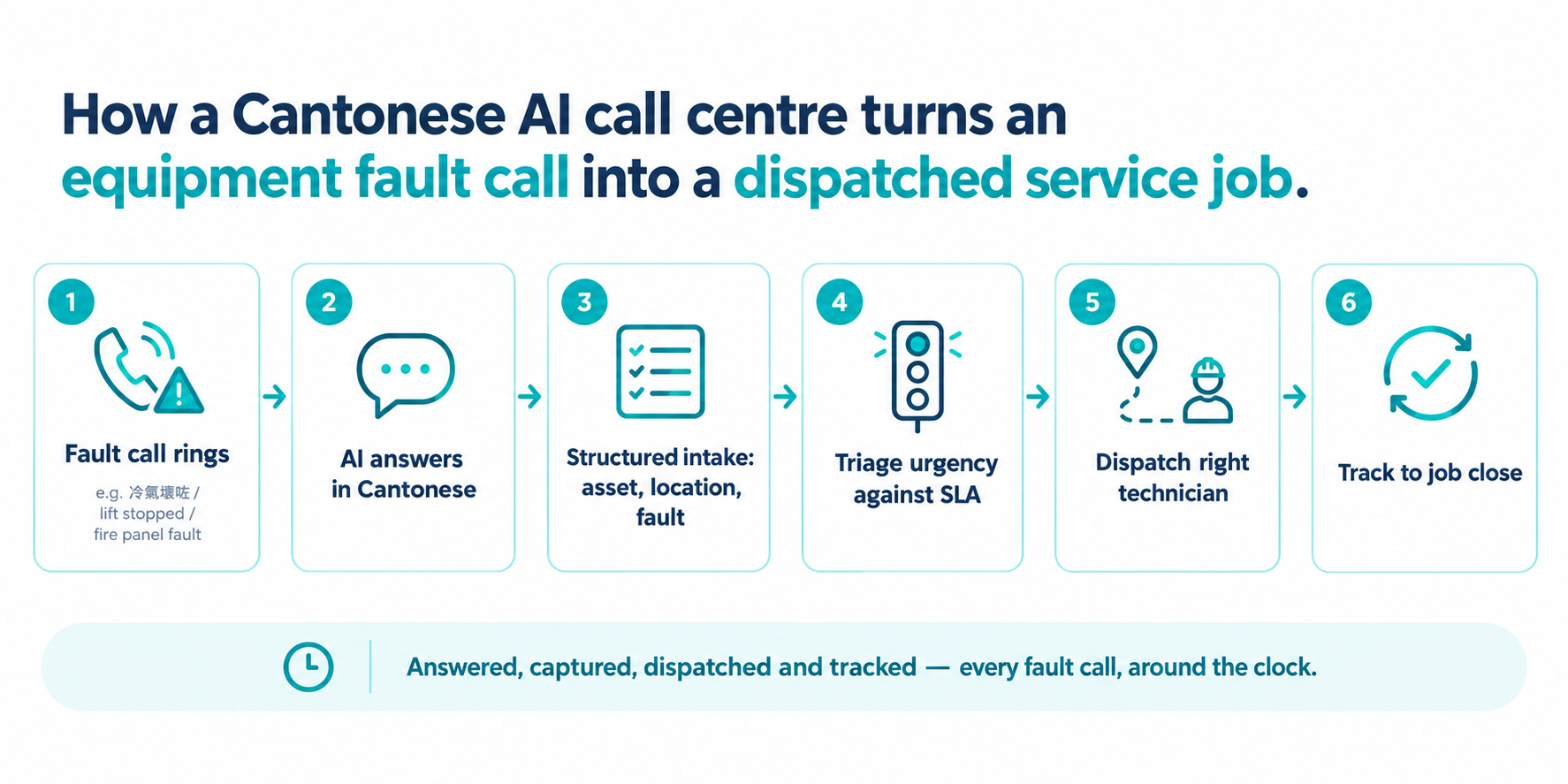
This is what a purpose-built Cantonese AI call centre changes. Instead of a coordinator who is sometimes on another call and always working from memory and a notepad, every fault call meets a system that is always on, always structured, and connected to your dispatch and job-management tools.
- Answer. First ring, 24/7, in natural Hong Kong Cantonese, Mandarin or English — including callers code-switching, using informal technical terms, or calling from a noisy plant room.
- Triage. Urgency classified against your SLA rules, with clarifying questions asked before classification.
- Capture. Customer, site, asset type, asset ID, location and fault description recorded in structured fields.
- Dispatch. The right technician notified with the full job record, then tracked through acceptance to job close.
The contrast with an answering service is direct: AI-driven dispatch rather than outsourced message-taking means the fault is actioned and tracked from the moment it is reported, not relayed as a message that waits in a queue until morning.
Fault triage: separating the urgent from the schedulable
Triage is the most operationally significant step, because urgency drives cost, resourcing and SLA risk at once. Sending a callout technician to every reported fault is unsustainable; deferring a genuine emergency is catastrophic. A working model looks like this:
| Priority | Equipment service examples | AI action |
|---|---|---|
| P1 — life safety / critical asset | Lift entrapment, fire system fault, medical equipment failure, total cooling loss in a data centre or cold room | Dispatch immediately and escalate to a human supervisor in parallel |
| P2 — urgent operational | Chiller down before service hours, escalator stopped, major HVAC fault, building power issue | Log and dispatch within the contracted SLA window, notify the account manager |
| P3 — routine / schedulable | Intermittent fault, minor performance degradation, single-unit issue in a non-critical environment | Log a ticket, schedule the next available slot, confirm with the caller |
Two design principles matter. The AI asks clarifying questions before it classifies — “係咪有人困喺入面?” (is anyone trapped in the lift?) moves a P2 to a P1 immediately. And ambiguous calls err toward escalation: a system built for equipment service must never silently downgrade a fault it is not certain about.
Asset identification and fault capture
The most expensive mistake in equipment service is dispatching the wrong technician — wrong trade, wrong certification, wrong parts — because intake was incomplete. A lift fault needs a registered lift contractor. A fire suppression issue needs a licensed fire services contractor. A chiller fault on a specific make and model needs someone who has serviced that unit before.
Getting that right on the first call requires structured intake, not a freeform chat. The AI asks in order: customer and site, asset type, asset ID or model, floor or location, fault description, and whether safety or operations are affected. Those fields populate a job record that reaches dispatch complete. This is precisely where Hong Kong smart building and FM operations still lose time: detection is fast, but information degrades at every handoff.
Technician dispatch: the right person, properly briefed
Triage tells you how urgent the job is. Capture tells you what the job is. Dispatch decides who goes and what they know on arrival — the step that determines whether the first visit fixes the fault or creates a second callout.
A connected AI call centre dispatches against your technician roster in real time: matching by trade and certification, by geographic zone, by on-call availability, and by familiarity with the asset or client site. What reaches the technician is not a verbal phone briefing but a structured job notification — client, site address, floor and location, asset type and ID, fault description, priority, SLA deadline, and access or safety notes. First-time fix rates go up; repeat and no-fault-found callouts go down.
Contracts, warranties and scheduled maintenance
Not every inbound call is a breakdown. A significant slice of phone volume is contract and maintenance enquiries: is this fault under warranty, when is the next statutory inspection, can I book a routine visit, when does the contract renew?
These matter commercially even when they feel routine. A customer who cannot get a clear answer on coverage starts questioning the value of the contract. A missed service booking becomes a lapsed inspection and a compliance issue. A renewal call that gets bounced around is a renewal that does not happen. A Cantonese AI call centre handles these end to end — reading coverage and renewal information from your records, booking visits into your scheduling system, and routing genuinely commercial questions to the right account manager, with every enquiry logged against the customer.
How to evaluate a Cantonese AI call centre for equipment service
Equipment service has requirements generic call centre platforms do not address. The criteria that matter:
- Built for Cantonese, not translated into it — tone-aware, trilingual by design, and hardened for plant-room audio, noisy sites and fast colloquial speech. A system that was never built to parse spoken Cantonese fails on the calls that matter most.
- Structured intake, not message-taking — asset type, location, fault description and urgency captured in fields, not a voice note forwarded to a coordinator.
- SLA-aware triage — urgency configurable against your contract tiers and statutory requirements, not a generic P1/P2/P3.
- Job-management integration — dispatches landing in your CMMS, FSM or job platform so the record is complete from first report to invoice.
- Audit trail for every call — timestamp, caller, fault description, triage classification, dispatch record and technician acceptance, exportable for SLA disputes.
- 24/7 across every contract — genuine round-the-clock intake, because equipment failure observes no office hours.
For a wider comparison against these criteria, our guide to the best Cantonese AI call centre solutions in Hong Kong for 2026 walks through the evaluation framework in detail.
The practical takeaway is simple. For an equipment service company in Hong Kong the fault call is not an administrative task — it is the commercial and contractual moment that defines the client relationship. A Cantonese AI call centre exists so that moment is never missed: answered on the first ring, captured in full, dispatched to the right person, and tracked to close, every time.
FAQ
Can the AI capture the specific asset details needed to dispatch the right technician?
Yes — structured intake is a core function. The system asks for asset type, model or ID, location and fault description in sequence, populating a complete job record that goes to dispatch, so the technician arrives knowing what they are walking into.
How does it triage urgency when the caller doesn't know the technical terms?
It asks clarifying questions instead of relying on the caller's vocabulary — “Is anyone trapped?”, “Has the system shut down completely, or is it still running?” When urgency is ambiguous, it errs toward escalation.
Does it work 24/7 for after-hours fault calls?
Yes, and this is the most critical capability. Statutory equipment generates faults at all hours, and SLA clocks start at the moment of report — not when the coordinator arrives in the morning.
Can it handle Cantonese, Mandarin and English from different clients?
Yes. It handles all three and the code-switching between them as standard, which matters for a client base spanning local building managers, mainland-linked clients and international facilities teams.
How does it integrate with our job-management or CMMS system?
Every fault report creates a structured job record that flows into your existing field service, CMMS or job-management workflow, rather than a parallel system someone has to copy from manually.
Can it answer contract and warranty enquiries accurately?
When connected to your contract records, yes — coverage status, next service dates and renewal information relayed accurately, with anything requiring commercial judgment routed to the right person.