
Summarize this article with AI(click one of the models and ctrl+v)





It's 9:45pm. A resident calls the management office, voice tight with frustration. 「三晚喇,樓上啲噪音仲未停,我已經打過兩次,個保安話會處理,但到而家都冇人嚟。我想 formal complain。」 (It has already been three nights. The noise from the upper floor never stops. I have called the management office twice and the security guard said they will handle it, but no one really came.)
That call is not a maintenance request. It is a complaint — and under Hong Kong's regulatory framework, it carries weight. The Property Management Services Authority (PMSA) requires licensed property management companies to maintain an effective complaint handling mechanism. Complaints can be lodged verbally or by phone, not only in writing. Once the words are spoken, the company has an obligation to record, investigate and respond.
Yet in most buildings, that obligation is still handled by a rushed note, a WhatsApp message, or a one-line entry that later disappears into someone's memory. Details vanish. Ownership is unclear. Follow-up slips. The resident calls again, angrier. By the time management learns of it, the issue has already become a formal dispute.
This is the quiet failure point in Hong Kong property operations: verbal complaints. They arrive unstructured, emotional, and often in code-switched Cantonese. And most systems are still built as if residents will carefully type a neat form. That is exactly why Cantonese voice AI matters more than an English chatbot for complaint handling.
Why complaint handling is different from ordinary call handling
A maintenance call is usually about a physical problem: a leak, a broken lift, a faulty air-conditioner. The goal is to dispatch the right trade quickly.
A complaint is different. It is about process, fairness and accountability. The resident wants to be heard, wants a record, and wants evidence that something will change. The conversation often wanders. It may reference previous calls, name specific staff members, describe three nights of the same issue, and end with a request for a formal letter or escalation.
When that conversation is reduced to "resident complained about noise," almost everything that matters is lost: the timeline, the prior contacts, the resident's expectations, the exact units involved, and the emotional temperature of the call. Once those details disappear, the complaint process starts weak. Investigation becomes guesswork. Response times stretch. Residents feel ignored. And the property company is left exposed if the matter escalates to the PMSA or to legal channels.
In short, complaint handling is not just customer service. It is risk management, reputation management and regulatory compliance rolled into one.
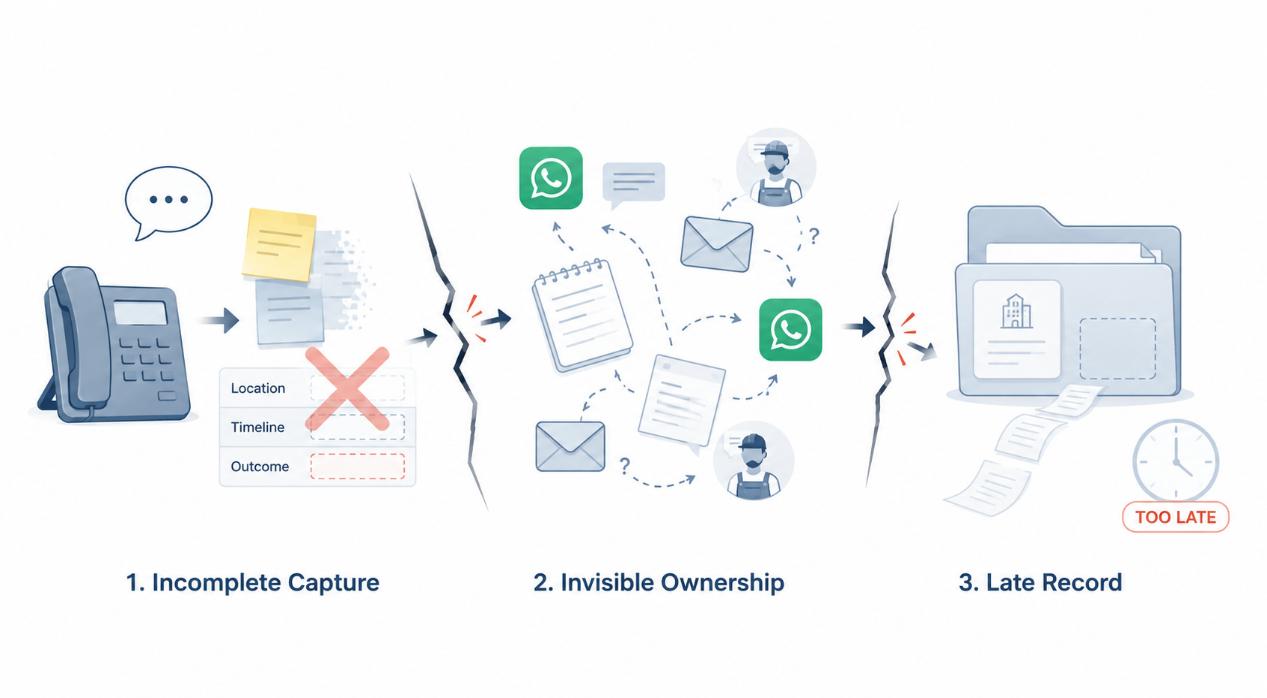
The three places verbal complaints usually break
- Capture is incomplete. Most frontline staff are under time pressure. They listen, they empathise, and they jot down the minimum. Location, timeline, previous reports, requested outcome and contact preference are frequently incomplete or inaccurate. A strong complaint record needs structured fields from the start, not a free-text summary someone has to reinterpret days later.
- Ownership and status become invisible. After the call ends, the case often moves across WhatsApp groups, email chains, site office notebooks and contractor messages. No single place shows who currently owns the complaint, what the next action is, or when the resident was last updated. The second (or third) call from the resident is usually the first clear signal that the workflow has failed — the same post-call gap that causes property call centres to fail once the conversation is over.
- The formal record is created too late — or not at all. Because the original conversation lived only in a note or in someone's head, reconstructing an accurate timeline later is difficult. Yet licensed managers are expected to maintain proper records of verbal complaints. When the paper trail is thin, the company is vulnerable.
These breakdowns are not caused by laziness. They are caused by tools and processes that were never designed for spoken, code-switched, emotionally charged Hong Kong property calls.
Cantonese voice AI vs. manual complaint handling
| Capability | Typical manual process | Cantonese voice AI approach |
|---|---|---|
| Handles natural spoken Cantonese + English mix | Depends on individual staff | Designed for it |
| Captures structured details in real time | Rarely | Yes — location, timeline, prior contacts, requested outcome |
| Creates a formal complaint record automatically | Manual, often incomplete | Yes, with timestamps and ownership |
| Classifies urgency and routes correctly | Inconsistent | Consistent, rule-based |
| Maintains full conversation history | Usually lost | Preserved and searchable |
| Supports PMSA-style complaint tracking | Ad-hoc | Built-in audit trail |
| Updates the resident without extra staff effort | Manual follow-ups | Automated status notifications |
A chatbot can answer "what are the quiet hours?" An English-first voice system may struggle with 「三晚喇,樓上仲未停,我想 formal complain。」 A purpose-built Cantonese voice AI treats that sentence as the start of a proper complaint workflow, not just another call to log.
What a strong complaint workflow actually looks like
- Structured intake in the moment. The system asks clarifying questions while the resident is still on the line: exact location, how long the issue has continued, previous reports, preferred contact method and desired outcome. Details are captured as usable data, not a vague note.
- Automatic classification and ownership. The complaint is tagged (noise, service standard, contractor behaviour, etc.), assigned a priority, and given a named owner — property officer, duty manager or complaints coordinator — with a clear next action and due time.
- Complete, searchable record. The original conversation (or a high-quality transcript), timestamps, status changes, staff notes and resident updates are kept together. This is the foundation for both fair investigation and regulatory readiness.
- Visible status and closed loop. The resident receives a reference number and subsequent updates. Management can see open complaints, approaching deadlines and patterns across the portfolio without waiting for end-of-day reports.
This is exactly the layer Routiq AI is built to provide. It is not a generic voice bot with a Cantonese option. It is designed around the real shape of Hong Kong property calls — including the messy, code-switched, emotionally charged ones that become formal complaints.
What property managers should check before choosing a system
- Does it handle natural Cantonese with English code-switching, or is Cantonese an afterthought?
- Can it extract structured complaint data (timeline, prior contacts, requested outcome) rather than just producing a transcript?
- Does it create an audit-ready record automatically, with ownership and status history?
- Can it connect to your existing work-order or case-management tools so the complaint does not become another silo?
- Are data governance, retention and access controls clear? Complaint records contain personal details and sensitive operational information.
The best system is not the one with the most natural-sounding demo voice. It is the one that survives a rushed 11pm call and still produces a usable, defensible record by the time the call ends.
Where humans still belong
AI should never be the final judge of a complex or sensitive complaint. Disputes involving neighbours, staff conduct, contractual interpretation or potential legal exposure still require human judgment, empathy and authority. The useful role of Cantonese voice AI is to make sure the human who eventually handles the case receives a complete, accurate starting point instead of a half-remembered note.
When the intake is solid, staff spend less time reconstructing what was said and more time resolving the actual issue. Residents feel heard. Management gains visibility. And the company is better prepared if the matter is later reviewed.
FAQ
Why do verbal complaints create more risk than written ones?
Because they are easy to under-record. Once the call ends, details that were never written down are gone. Under the PMSA code of conduct, licensed managers are expected to maintain an effective mechanism that covers verbal and telephone complaints. Incomplete records turn a manageable issue into a compliance and reputation problem.
Is an English chatbot enough for complaint handling in Hong Kong?
No. Most urgent or emotional complaints arrive by phone, in Cantonese mixed with English. A text-only English tool never enters the conversation.
Does voice AI replace the complaints officer?
No. It handles intake, structuring, classification and basic routing so that human staff receive complete cases and can focus on investigation, negotiation and resolution.
What should we look for in a Cantonese voice AI for complaints?
Native handling of spoken Cantonese and code-switching, structured data capture (not just transcripts), automatic creation of complaint records with ownership and timestamps, integration with existing systems, and clear data governance.
How quickly can this kind of system be put to work?
Most operators begin with high-volume call types and expand. Complaint-specific workflows can usually be configured and tested within weeks rather than months.
If your current process still relies on handwritten notes, scattered WhatsApp messages or English-first tools to handle verbal complaints, the gap is larger than it appears. Residents are already speaking in the language and channel that feel natural to them. The systems that protect both service quality and regulatory standing are the ones built to meet them there.